Quick answer
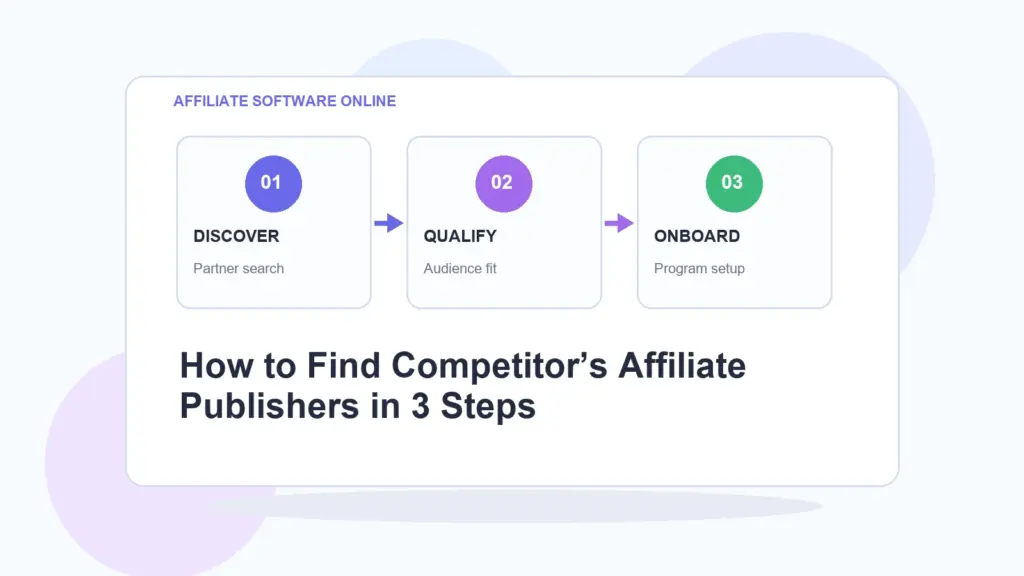
To find competitors’ affiliate publishers, search for pages that recommend competing products, inspect the links and disclosures to confirm a commercial relationship, then shortlist publishers whose audience fits your offer. Record the evidence and date for each candidate. A link to a competitor shows promotion, not the publisher’s revenue or willingness to work with you.
A merchant can learn from the sites that already answer its buyers’ questions. Competitor research is useful for recruitment, but the usual “find their top affiliates” pitch overstates what public evidence can show. You can see a review, an affiliate link or a disclosure. You generally cannot see the contract, commission, conversion rate or private traffic behind it. Treat the research as a way to build a relevant prospect list.
Step 1: Search the questions buyers actually ask
Start with the product category and the decisions a buyer makes, not a list of affiliate networks. For a CRM merchant, useful searches might include “CRM for a two-person sales team,” “CRM with Outlook sync” or “[competitor] alternatives.” Add industry, budget or integration terms that match your offer. Review product comparisons, tutorials, specialist newsletters and community resources that appear for those questions.
Search the competitor’s name with terms such as “review,” “alternatives,” “discount,” “partner” and “affiliate.” Check the competitor’s public partner directory if it has one. A backlink tool can help find additional pages linking to a competitor, but do not assume every backlink is an affiliate placement. A news article, customer case study or reseller page may have a very different relationship.
Take a small, repeatable sample of relevant searches and record the date and location. Search results change by market, device and time. The old article described a particular CRM search result as if it were a permanent map of the category; it was only an unverified snapshot.
Step 2: Check whether each publisher is a plausible partner
Open the page and read it. Does it explain how the product works, who it suits and where it falls short? Is it maintained? Is the promoted competitor relevant to your own buyer? A high-ranking listicle that names dozens of unrelated products may send less useful demand than a smaller specialist guide that answers a narrow implementation question.
Inspect the link and surrounding copy. A tracked or redirected URL, coupon code or affiliate disclosure can indicate a commercial relationship. The US FTC guidance explains why material connections should be disclosed to readers. But a normal link does not prove the absence of a deal, and a tracking link does not reveal the deal’s economics. Do not describe an observed publisher as a “top performer” unless you have real performance evidence.
| Evidence to record | What it helps answer | What it cannot prove |
|---|---|---|
| Relevant comparison or tutorial URL | Which buyer question the publisher serves. | How many qualified referrals the page produces. |
| Link destination, redirect or coupon | Whether a commercial tracking route appears to be in use. | The commission rate or attribution rule. |
| Disclosure and update date | How the relationship is presented and whether the page appears maintained. | That every linked offer is current. |
| Audience and editorial fit | Whether your product belongs in the publisher’s coverage. | That the publisher wants another brand. |
Save the exact page URL, publisher name, observed competitor, evidence, date, likely buyer, contact route and any concern. Use “possible affiliate” when the relationship is uncertain. Do not turn an SEO tool’s estimated visits into a claimed count of referred customers.
Step 3: Offer a reason to cover your product
Before contacting a publisher, compare the actual products. What can your offer do for the reader that the promoted competitor cannot? Is it cheaper under a specified use case, easier to integrate with a named system, available in a market the other product does not serve, or more suitable for a narrower team? Verify the distinction on current product documentation and pricing pages. “Higher commission” may interest a publisher, but it is a poor substitute for reader fit.
A useful pitch names the page and its audience, states the specific comparison worth checking, gives access to accurate product information and explains the partner terms. Let the publisher test or challenge the claim. Do not ask for a disguised endorsement or demand that a rival be removed. The best outcome might be a fair comparison that says your product is a worse fit for some buyers and a better fit for others.
Assess the partner’s methods before an offer. Check disclosure habits, paid-search and trademark use, coupon practices, content quality and whether the site sends users to a genuine product destination. Set expectations for approved claims, links and payout in writing. The site’s affiliate recruitment guide covers the broader partner search; competitor research is one source of candidates.
What to do when the search produces little
Some categories have few public affiliate links. B2B consultants may make private introductions; software resellers may work through contracts rather than tracked content links. A competitor’s partner directory may omit active publishers, and a backlink index may miss or misclassify redirects. Do not fill the gap with guesses. Look at niche publications, integration partners, educator communities and customer advocates who answer the same buyer questions.
After recruiting a small group, measure accepted referrals and eventual sales under your own rules. That is the first point at which you can say whether a publisher works for your program. Public competitor research can tell you where to begin; your own records tell you whether to continue.
Frequently asked questions
How do I find my competitors’ affiliate publishers?
Search buyer questions and competitor comparisons, inspect relevant pages for tracked links or disclosures, and record publishers whose audience fits your product. Verify the relationship where possible before calling someone an affiliate.
Can a backlink tool show every affiliate promoting a competitor?
No. It can suggest pages to inspect, but links may be redirected, omitted, private or unrelated to an affiliate deal. Read the page and treat tool data as a lead, not proof of a contract.
Does an affiliate link prove a publisher earns a lot from that competitor?
No. A public link can show that a tracking route exists; it does not reveal clicks, conversions, commission rate, reversals or payout. Do not rank publishers by assumed earnings.
Should I offer a higher commission than my competitor?
Only if the economics support it and your product is genuinely useful to the publisher’s readers. Give the publisher an accurate product distinction, clear terms and reliable support. A higher rate cannot fix poor audience fit.
What should I record in a competitor-affiliate prospect list?
Save the exact page and publisher, promoted product, link or disclosure evidence, observation date, audience fit, contact route and concerns. Mark uncertain relationships as possible affiliates rather than confirmed partners.
Can I recruit a publisher that promotes a competing product?
Often, but check the publisher’s existing obligations and your own program rules. Approach with a specific reason your product deserves consideration and allow an independent comparison; do not assume exclusivity or demand that the rival be removed.