Quick answer
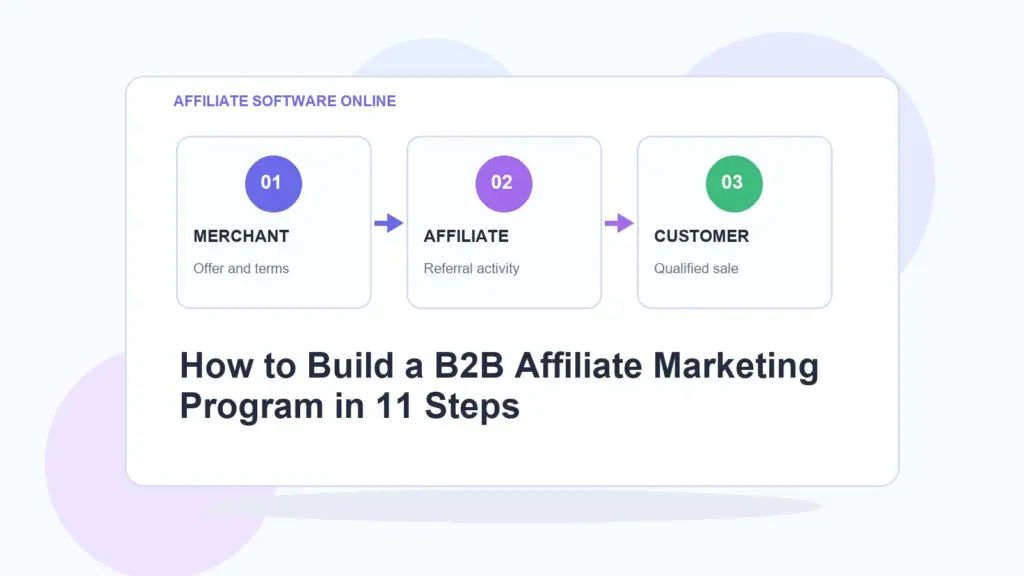
To build a B2B affiliate program, decide which partners can introduce buyers, define a qualified referral, and pay for an outcome your sales team can verify. Set deal ownership and commission rules before recruiting anyone. Connect referral records to your CRM, test a complete lead-to-payment journey, then launch with a small group of relevant partners. Paying for raw form fills is a poor shortcut when deals take months to close.
B2B affiliate marketing is easy to oversell. A vendor can produce links and a dashboard in an afternoon; that does not settle who introduced an account, whether the buyer was already in your pipeline, or when the partner has earned a commission. Those decisions determine whether a program is useful to sales and fair to partners.
This guide is for a company selling to businesses through a sales process: software, services, equipment or another considered purchase. If customers buy immediately through a checkout, the tracking work may be simpler. If an account has several contacts, a long evaluation and a negotiated contract, build the program around the account and the deal.
What counts as a B2B affiliate?
A B2B affiliate promotes your offer to an audience and earns under an agreed referral rule. A consultant who makes a personal introduction may be better described as a referral partner. A reseller buys or sells under a different commercial arrangement. These labels matter less than the partner’s actual role, but mixing them in one set of terms creates avoidable disputes.
| Relationship | Typical contribution | Point to settle in the agreement |
|---|---|---|
| Content affiliate | Publishes a review, comparison or educational resource that sends interested buyers to you. | How a click or lead becomes an attributable sale. |
| Referral partner | Introduces a named account or contact. | Whether the account was already known and when registration expires. |
| Agency or consultant | Recommends you while advising a client. | Disclosure, client consent and conflicts of interest. |
| Reseller | May negotiate, package or sell the product. | Commercial margin and responsibility for the customer relationship. |
How to build the program in 11 steps
1. Decide what the channel is supposed to produce
Pick one initial outcome: qualified opportunities in a particular market, sales of a defined product, or introductions to a specific buyer group. Do not use “more leads” as the objective. A lead with no buying authority, fit or intent gives your sales team work without creating a plausible deal.
2. Define your ideal customer and exclusions
Write down the company size, geography, industry, use case and buyer role that your team can serve. Add exclusions: existing customers, active opportunities, unsupported countries, prohibited traffic sources and accounts already assigned to another partner. Give partners this brief before they promote you. They cannot send good prospects if you hide the qualification rules.
3. Choose the partner type before choosing software
A niche publisher with a useful comparison page needs trackable links and landing pages. A consultant introducing named accounts needs a registration and approval process. An agency may need both. Buying an affiliate platform because it advertises unlimited links is premature if the actual problem is account ownership in your CRM.
4. Define a qualified referral
Specify the event that earns consideration for commission. A form submission may be enough for a low-cost product. For a sales-led product, it is usually safer to require a new account in your target market, a valid contact, an expressed use case and sales acceptance. Spell out duplicate handling and the period in which an accepted referral remains protected. Partners should be able to see whether a submission was accepted, rejected or pending, with a reason.
5. Set the commission on an economic basis
Choose a flat amount per approved customer, a share of collected first-year revenue, or a recurring share for a fixed period. Calculate what each model costs after discounts, refunds, sales expense and delivery cost. A recurring commission may suit a subscription; a one-time fee may be easier for a service contract. Do not promise a lifetime share merely because it sounds attractive. Define what happens when the customer upgrades, downgrades, cancels, fails to pay or changes account ownership.
Published commission rates from other programs can help a partner compare offers, but they are a poor basis for setting your own. Use your unit economics and a partner agreement that finance can administer.
6. Write attribution and deal registration rules
State whether a partner earns credit through a tracked link, coupon, accepted account registration or documented introduction. Define the lookback window, priority when two partners claim the same account, treatment of existing opportunities, and an appeal process. Salesforce’s deal-registration documentation is one example of the account-level workflow that a B2B program may need. The point is not to buy Salesforce; it is to make the claim and approval process explicit.
7. Connect partner activity to sales records
Keep the partner ID, referral source, account, contact, opportunity and payout status linked. A website click alone cannot tell you whether a six-month deal closed. If you use Google Analytics, its recommended lead events distinguish an initial generate_lead event from qualification and a converted lead. Your CRM still needs to be the source for account ownership, contract value and payment status. Check how identifiers move between the landing page, form, CRM and billing system.
8. Create partner material that answers buyer objections
Give partners accurate product descriptions, who the offer is for, pricing boundaries if public, implementation requirements and reasons a buyer might choose an alternative. A comparison page that hides limitations may generate clicks but weakens the partner’s credibility and sends poorly matched prospects. Require approval for claims about performance, compliance or guaranteed results that your team cannot substantiate.
9. Recruit a small, relevant first group
Start with publishers, consultants or agencies that already reach the buyer you described in step 2. Examine their actual content and audience before inviting them. A large roster of dormant partners is not a distribution strategy. Ask each candidate what buyer question they can answer and how they plan to disclose the commercial relationship. The FTC’s endorsement guidance explains why a paid connection may need clear, conspicuous disclosure in US-facing promotion; check the rules that apply to your markets.
10. Test one complete referral before launch
Use a test partner and a test buyer. Follow the referral from link or introduction through form submission, duplicate review, sales acceptance, opportunity creation, invoice, commission approval and a refund or cancellation. Check what the partner can see at each stage. If a sales rep has to repair the record manually, document that process before inviting more partners.
11. Review quality and disputes, then expand
Measure accepted opportunities, closed revenue, time to close, commission as a share of collected revenue, rejected referrals and disputes. Compare those by partner and by partner type. Visits and sign-ups may help diagnose a funnel, but they should not stand in for sales quality. Review partner feedback too: slow acceptance and opaque rejections can drive away the few partners worth keeping.
Which payout model is least likely to create trouble?
| Model | Useful when | Main risk |
|---|---|---|
| Per raw lead | The lead is easy to validate and has predictable value. | Incentivizes volume even when sales cannot use the leads. |
| Per sales-accepted opportunity | There is a written qualification standard and timely review. | Partner trust suffers if acceptance is subjective or hidden. |
| Per closed, paid customer | The CRM and billing records can identify the referred account. | Long sales cycles delay payout; partners need status visibility. |
| Share of recurring revenue | Subscription billing and commission adjustments are reliable. | Upgrades, refunds and cancellations complicate the ledger. |
For a new sales-led B2B program, I would usually start with an accepted opportunity plus a commission on the first paid contract, with clear milestones and a deadline for reviewing registrations. That gives the partner evidence of progress without rewarding a pile of unqualified forms. It is a policy choice, not a universal formula: the right payout depends on deal value, sales cycle and margins.
Frequently asked questions
What is a B2B affiliate program?
It is a partner program that pays an external publisher, consultant or other promoter for a defined business-customer outcome, such as an accepted opportunity or paid sale. The agreement should specify qualification, attribution, commission and exclusions.
How is a B2B affiliate different from a referral partner?
A content affiliate often attracts buyers through published material and tracked links. A referral partner may introduce a named company or contact directly. One person can do both, but account registration and commission rules may need to differ.
Should B2B affiliates be paid for leads or sales?
Pay for an event you can validate and afford. Raw leads are easy to generate but can be low quality. Sales-based commissions better reflect revenue, though long sales cycles delay payout. Some programs acknowledge an accepted opportunity and pay the main commission after the first paid contract.
How do you track affiliate sales with a long B2B sales cycle?
Carry the partner ID or accepted registration from the first interaction into the CRM account and opportunity, then connect the closed deal to billing and commission records. A click report alone does not establish who earned a commission months later.
What happens if two partners refer the same company?
Apply the priority and expiration rules in your agreement. Check whether either partner registered an accepted opportunity, whether the account was already in your pipeline, and whether the later partner made a distinct contribution. Record the decision and give both partners a way to challenge errors.
How many partners should a new B2B affiliate program recruit?
Start with a small group that reaches your defined buyers and can produce a credible recommendation. There is no useful universal number. Expand after your team can approve referrals promptly, track closed deals and resolve attribution disputes.