The best affiliate tracking software for a small business is the one that tracks referrals accurately, fits your sales model, is easy enough for your team to manage, and does not force you into an enterprise workflow before you need one.
For a small business, the right choice depends on what you sell:
| Business type | Best-fit tracking approach |
|---|---|
| Shopify or ecommerce store | Ecommerce-friendly affiliate app with coupon, product, and order tracking |
| WordPress or WooCommerce site | WordPress affiliate plugin or lightweight self-managed tracking setup |
| SaaS or subscription business | Tool that handles trials, recurring billing, Stripe or Paddle, and customer lifecycle events |
| Creator or digital product business | Simple affiliate links, payout workflow, and clean partner dashboard |
| Service business | Lead tracking, form attribution, manual approval, and CRM-friendly reporting |
| Growing partner program | More advanced commissions, fraud controls, partner communication, and reporting |
Do not choose affiliate tracking software only because it has the longest feature list. Small businesses usually need clarity before complexity: reliable attribution, simple affiliate signup, transparent commission rules, easy payouts, and reporting you can understand without hiring an operations team.
If you are still new to the model, read this guide on how to get into affiliate marketing first. If you are choosing tools for a beginner site, use the beginner affiliate tool stack as the practical starting point.
What Is Affiliate Tracking Software?
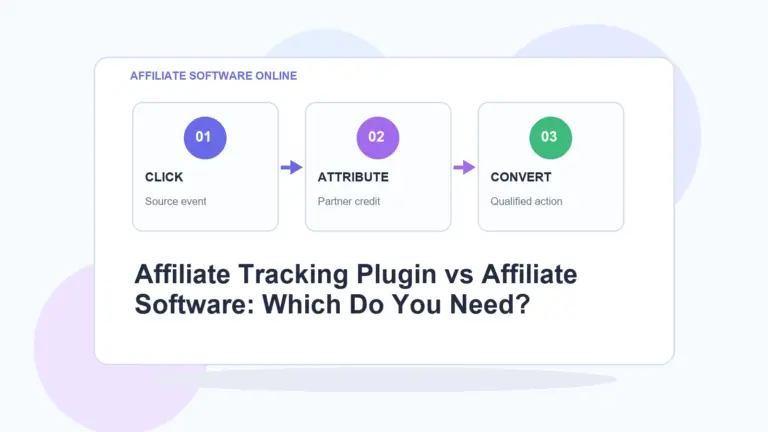
Affiliate tracking software records the clicks, referrals, leads, sales, signups, or other conversion events generated by your affiliates. It connects an affiliate's promotion to the result your business cares about.
A typical system handles:
- Affiliate registration
- Referral links or coupon codes
- Click tracking
- Conversion attribution
- Commission rules
- Affiliate dashboards
- Payout reporting
- Fraud or abuse checks
- Performance reports
For a small business, the goal is not to build a complicated partner machine on day one. The goal is to know who referred a customer, what they earned, and whether the program is worth expanding.
What Small Businesses Actually Need
Small businesses have different needs from large affiliate networks or enterprise partnership teams. You probably do not need a giant partner portal, a complex marketplace, and custom contract workflows on day one.
You do need:
| Requirement | Why it matters |
|---|---|
| Accurate tracking | Affiliates need trust that referrals are recorded correctly |
| Simple setup | A small team cannot spend months implementing tracking |
| Clear commission rules | Confusing payouts create support problems and partner frustration |
| Affiliate dashboard | Partners need links, performance data, and basic resources |
| Payout workflow | You need a clean way to review and pay commissions |
| Integration fit | The tool should work with your store, site, payment processor, or CRM |
| Fraud controls | Coupon abuse, self-referrals, and low-quality traffic can damage the program |
| Reporting | You need to see which affiliates and pages are producing value |
If a platform cannot answer "who referred this sale?" and "what do we owe them?" clearly, it is not ready for your affiliate program.
Minimum Viable Affiliate Tracking Stack
Before comparing software, define the minimum system your business needs.
For a small ecommerce store:
- Affiliate signup page
- Unique links or coupon codes
- Order attribution
- Commission rules
- Payout report
- Basic fraud review
For a SaaS startup:
- Referral links
- Trial signup tracking
- Paid conversion tracking
- Recurring commission support if you offer recurring payouts
- Stripe, Paddle, or billing integration
- Cancellation, refund, and downgrade handling
For a WordPress business:
- WordPress-compatible tracking
- Affiliate dashboard
- WooCommerce, Easy Digital Downloads, form, or payment integration if needed
- Commission settings
- Link and coupon tracking
- Reports inside the WordPress workflow
If you only need to manage links on an affiliate content site, start with how to track affiliate links in WordPress. If you are running your own affiliate program, compare broader options in the guide to the best affiliate tracking software.
Best Affiliate Tracking Software By Small-Business Use Case
There is no universal winner. The best tool depends on the business model.
| Use case | Tools to consider | Why they may fit |
|---|---|---|
| Shopify merchant starting a creator or affiliate program | Shopify Collabs, GoAffPro, Refersion, Tapfiliate | Ecommerce workflow, product/order tracking, coupon support, Shopify-friendly setup |
| WordPress or WooCommerce business | AffiliateWP, ASO plugin, other WordPress affiliate plugins | Fits the WordPress admin workflow and can keep ownership closer to the site |
| SaaS using Stripe or Paddle | Rewardful, FirstPromoter, PartnerStack, Tapfiliate | Subscription and recurring-revenue programs need billing-aware attribution |
| Small ecommerce brand with growth plans | Refersion, Tapfiliate, LeadDyno | Useful when you need affiliate dashboards, integrations, reporting, and payouts |
| Budget-conscious first program | GoAffPro, Shopify Collabs, lightweight WordPress options | Lower-cost entry points can help validate the channel before scaling |
| More complex partner program | Impact, PartnerStack, Everflow, TUNE | Better fit when the program needs partner operations, advanced attribution, or network-level reporting |
This page is for small businesses, so the best starting point is usually not the most powerful enterprise platform. Start with the simplest system that can track correctly, pay fairly, and grow with the program.
Tool Notes For Small Businesses
Shopify Collabs
Shopify Collabs is built for Shopify merchants that want to work with creators and affiliates from inside the Shopify ecosystem. It can be a practical starting point for Shopify stores because it is native to the platform and supports merchant workflows for inviting creators, managing programs, and providing affiliate links.
Best fit: Shopify stores that want an integrated creator and affiliate workflow.
Watch out for: It is not a general-purpose affiliate platform for every business model. If you are not on Shopify, choose a different option.
GoAffPro
GoAffPro is a common small-business choice because it offers a low-friction entry point and ecommerce-friendly affiliate program features. Its documentation highlights a free Hobby plan plus paid plans for more advanced needs.
Best fit: Budget-conscious ecommerce merchants that want to test an affiliate program before moving into heavier software.
Watch out for: Review the current plan limits, integrations, and payout workflow before committing.
Tapfiliate
Tapfiliate is a flexible affiliate tracking and management platform with integrations for ecommerce and subscription workflows. Its pricing page highlights integrations, real-time reporting, recurring commissions, coupon tracking, affiliate payment methods, and bulk actions on current plans.
Best fit: Small businesses that want a broader affiliate management platform instead of a single-platform app.
For small businesses that expect the program to grow into a serious partner channel, Scaleo is worth evaluating early. It is not the lightest starter option, but it gives more room for tracking, reporting, fraud review, and partner operations than a simple plugin.
Watch out for: Confirm whether the integrations and plan limits match your store, checkout, and commission model.
Refersion
Refersion focuses heavily on ecommerce affiliate and influencer programs. Its current pricing/features page lists marketplace listing options, affiliate management, first-party tracking, commission structures, payout options, and integrations.
Best fit: Ecommerce brands that want affiliate management, marketplace visibility, first-party tracking, and more structured program operations.
Watch out for: Pricing can include subscription and performance-based components depending on plan. Recheck current pricing before publishing exact numbers.
Rewardful
Rewardful is built for SaaS and subscription businesses using Stripe or Paddle. Its documentation describes it as a way for subscription businesses to create and manage affiliate programs, and its pricing page notes Stripe/Paddle support and recurring-program workflows.
Best fit: SaaS, membership, and digital subscription businesses.
Watch out for: If your business does not use Stripe or Paddle, Rewardful may not be the right fit.
LeadDyno
LeadDyno positions itself as affiliate management software for ecommerce brands, SaaS businesses, and other companies that want to grow affiliate program revenue. Its pricing page emphasizes automated link tracking, commissions, communications, and unlimited clicks/conversions on current plans.
Best fit: Small businesses that want a managed affiliate platform with communication and tracking features.
Watch out for: Check active-affiliate limits, usage rules, and which features are available on each plan.
AffiliateWP
AffiliateWP is a WordPress affiliate plugin. Its pricing page makes the positioning clear: it works for WordPress sites and includes affiliate tracking, dashboards, referral links, coupons, reporting, and commission features depending on plan.
Best fit: WordPress and WooCommerce businesses that want affiliate management inside their own WordPress environment.
Watch out for: It is not for non-WordPress sites. Also check renewal pricing and plan features before choosing.
Free vs Paid Affiliate Tracking Tools
Free or low-cost tools can be useful when you are validating whether affiliates can bring sales at all. Paid tools become more important when the program starts creating operational pressure.
| Situation | Free or low-cost may be enough | Paid software is usually better |
|---|---|---|
| First affiliate test | Yes | Not always |
| Few affiliates | Usually | Only if tracking is complex |
| Shopify-only creator program | Often | If you need more control or reporting |
| SaaS recurring commissions | Rarely | Usually |
| Multi-tier commissions | Rarely | Usually |
| Fraud controls | Limited | Usually |
| Custom reports | Limited | Usually |
| Multiple products or stores | Sometimes | Often |
Use this deeper guide to compare free vs paid affiliate tracking tools.
Features To Compare Before Choosing
Tracking method
Look at how the tool tracks referrals:
- Referral links
- Coupon codes
- First-party tracking
- Server-side or postback tracking
- Customer email matching
- Manual conversion approval
- Product-level tracking
Cookie-only tracking may be too limited for some businesses. SaaS and ecommerce teams should understand how the platform handles subscriptions, refunds, cancellations, and repeat purchases.
Commission rules
Small businesses often start with one simple commission rate. That is fine. But check whether the tool can support the rules you may need later:
- Percentage commissions
- Flat commissions
- Product-specific commissions
- Recurring commissions
- Lifetime commissions
- Tiered commissions
- Bonuses
- New-customer-only commissions
Do not make commission rules complicated just because the software allows it. Start simple enough that affiliates can understand the program.
Payout workflow
Payouts are where messy programs become painful. Check:
- How commissions are approved
- Whether refunds reverse commissions
- Which payout methods are supported
- Whether invoices or exports are available
- Whether the tool supports PayPal, bank transfer, manual payout, or payout integrations
- Whether tax paperwork is your responsibility
Small businesses should avoid payout workflows that require a manual spreadsheet every month unless the program is tiny.
Affiliate experience
Affiliates need easy access to:
- Referral links
- Coupon codes if used
- Program terms
- Creative assets
- Commission status
- Payout status
- Basic performance data
If affiliates constantly email you asking for their links, stats, or payout status, the dashboard is not doing its job.
Integrations
Choose software that fits your actual sales system.
Common integrations include:
- Shopify
- WooCommerce
- BigCommerce
- Stripe
- Paddle
- Chargebee
- PayPal
- Email platforms
- CRM tools
- Analytics tools
Do not buy software for integrations you might someday need. Buy for the checkout and reporting workflow you use now, while leaving room to grow.
Fraud and abuse controls
Small affiliate programs can still attract bad behavior. Watch for:
- Self-referrals
- Coupon leakage
- Brand bidding
- Fake leads
- Low-quality traffic
- Repeated refunds
- Suspicious conversion patterns
Your software should help you review conversions, block abuse, and define clear program rules.
Setup Checklist Before Inviting Affiliates
Before you invite partners, confirm:
- The tracking link records clicks.
- A test conversion is attributed correctly.
- The commission amount is calculated correctly.
- Refunds and cancellations are handled correctly.
- Affiliates can access their dashboard.
- Payout rules are written clearly.
- Program terms prohibit spam, coupon abuse, and misleading promotion.
- Your disclosure expectations are clear.
- You know who approves affiliates.
- You know when and how affiliates get paid.
This is the boring work that prevents angry emails later.
Pricing Readiness Checklist
Before paying for affiliate software, ask:
- How many affiliates are included?
- Are clicks and conversions unlimited?
- Are there transaction fees or revenue-share fees?
- Does the plan include the integrations you need?
- Does the plan include recurring commissions if you need them?
- Does the plan support your payout workflow?
- What happens if you exceed plan limits?
- Is support included?
- What is the renewal price?
- Can you export your data?
Small businesses should be especially careful with pricing that looks low but adds fees based on affiliates, conversions, revenue, or usage.
Common Mistakes Small Businesses Make
Choosing software before defining the program
Software cannot fix unclear commission rules, weak offers, or poor affiliate fit. Define the program first.
Ignoring test conversions
Always run test clicks and test conversions before inviting real affiliates.
Overcomplicating commissions
Start with a simple commission structure. Add tiers and bonuses after you know what behavior you want to reward.
Forgetting internal links and content support
Affiliate programs need content support. Your site should explain the offer, answer buyer questions, and give affiliates pages worth sharing.
Choosing a tool that does not fit the sales model
A Shopify app may not fit a SaaS business. A SaaS affiliate tool may not fit a WooCommerce store. Match software to how you actually sell.
Publishing vague program terms
Spell out what affiliates can and cannot do. Include rules for paid search, coupons, email, social media, disclosure, refunds, and prohibited traffic.
Final Recommendation
Sources And Methodology
This guide is written for small-business buyers comparing affiliate tracking tools, not enterprise partnership teams. It uses official vendor pages where specific tools are discussed, ASO's internal software cluster, and small-business workflow criteria: setup difficulty, tracking reliability, payout clarity, partner reporting, fraud risk, and upgrade path. It does not use exact prices because software plans change too often for old numbers to age gracefully.
For a small business, the best affiliate tracking software is the one that fits your sales model and gives you trustworthy tracking without unnecessary complexity.
Choose by use case:
- Shopify store: start with Shopify-native or ecommerce-friendly options.
- WordPress site: consider WordPress affiliate plugins or lightweight WordPress-compatible tracking.
- SaaS business: prioritize subscription-aware tracking and billing integrations.
- Budget-conscious first program: start simple and upgrade when tracking or payout workflows become limiting.
- Growing program: choose software with stronger reporting, fraud controls, commission flexibility, and affiliate communication.
Do not wait until affiliates are already sending traffic to think about tracking. Set up the minimum system first, test it, then invite partners.
FAQ
What is the best affiliate tracking software for small business?
The best option depends on your business model. Shopify stores usually need ecommerce-friendly affiliate tools, WordPress businesses may prefer WordPress plugins, and SaaS companies need subscription-aware tracking that works with their billing system.
Do small businesses need affiliate tracking software?
If you run your own affiliate program, yes. You need a reliable way to track referrals, calculate commissions, give affiliates links or codes, review conversions, and manage payouts.
Can I start with free affiliate tracking software?
Sometimes. Free or low-cost tools can help validate a small program, but paid software is often better when you need recurring commissions, fraud controls, integrations, payout workflows, or better reporting.
What features matter most for a small affiliate program?
The most important features are accurate tracking, simple setup, clear commission rules, affiliate dashboards, payout reporting, integration with your sales system, and basic fraud controls.
Is affiliate tracking software the same as affiliate link tracking?
No. Affiliate link tracking usually measures clicks on links. Affiliate tracking software for a program also tracks referrals, conversions, commissions, affiliate accounts, and payouts.
Should I choose the cheapest affiliate software?
Not always. The cheapest option is useful only if it tracks accurately and fits your workflow. A low monthly price can become expensive if reporting is weak, integrations are missing, or payouts become manual.