Quick answer: A referral link is a unique URL used to track which affiliate, partner, customer, creator, or campaign sent a visitor to a website. When someone clicks the referral link, the website can identify the referral source, record the visit, and connect a later conversion or commission to the correct person.
Referral link in one sentence
A referral link is a trackable link that tells a website: “this visitor came from this specific person, partner, affiliate, or campaign.”
That is the entire job. Elegant, useful, and only mildly less dramatic than people make it sound.
Written by Elizabeth Sramek.
My opinion: referral links are one of the most underrated parts of online business. They look boring because they are “just links,” but they quietly decide who gets credit, which partner gets paid, and which campaign is actually working. Without them, referral marketing becomes a guessing game with invoices attached. Not ideal.
What is a referral link?
A referral link is a unique URL assigned to a person, affiliate, partner, customer, creator, or campaign so a website can track where a visitor came from. Referral links are commonly used in affiliate programs, referral programs, influencer campaigns, partner marketing, creator promotions, and word-of-mouth campaigns.
A referral link usually contains a unique identifier, such as a referral code, affiliate ID, partner code, or tracking parameter.
Example referral link:
https://example.com/?aso_ref=partner-codeIn this example, partner-code identifies the person or affiliate who shared the link. When someone clicks it, the website can record that the visitor came from that source.
If you want the broader tracking concept, start with What Is Affiliate Tracking?. This article focuses specifically on referral links.
Referral link example
Let’s say you have an affiliate named Anna. You assign Anna the referral code:
annaHer referral link becomes:
https://example.com/?aso_ref=annaWhen Anna shares this link and someone clicks it, the website can identify Anna as the referral source. If that visitor later buys, signs up, books a call, submits a lead form, or completes another qualifying action, Anna can be credited.
A cleaner campaign version may look like this:
https://example.com/go/anna-guide/That short link is easier to share in newsletters, social posts, videos, podcast notes, partner pages, PDFs, and online communities. Behind the scenes, it can still connect the click or referral activity to Anna.
How referral links work
A referral link works by passing a unique identifier to the website when someone clicks the link. The website reads that identifier, records the referral source, and may store a cookie so the referral can be remembered if the visitor converts later.
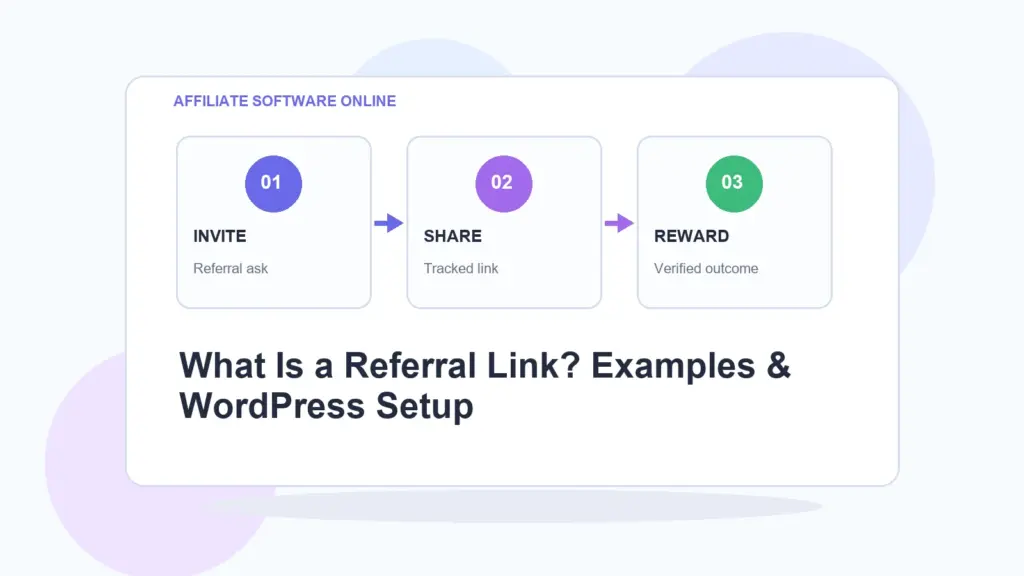
A typical referral link flow looks like this:
- A site owner creates an affiliate, partner, or referral source.
- The system assigns that person a unique referral code.
- The person receives a referral link.
- A visitor clicks the link.
- The website records the referral visit.
- A cookie may store the referral source.
- If the visitor later completes a qualifying action, the referral can be credited.
This is the basic logic behind affiliate tracking, referral marketing, partner attribution, and commission tracking.
Referral link vs affiliate link
Referral links and affiliate links are closely related. In many cases, people use the terms interchangeably. The difference usually comes down to the type of program.
| Term | Meaning | Common use |
|---|---|---|
| Referral link | A trackable URL that identifies who referred a visitor. | Referral programs, customer referrals, partner referrals, creator campaigns. |
| Affiliate link | A referral link used in an affiliate program, usually connected to commissions. | Affiliate marketing, creator partnerships, publisher promotions, revenue sharing. |
| Tracking URL | A broader term for any URL used to track source, campaign, click, or attribution data. | Ads, email campaigns, affiliate links, analytics tracking. |
My practical view: every affiliate link is a referral link, but not every referral link is an affiliate link. A customer referral link may reward store credit. An affiliate link usually rewards commission. Same plumbing, different business model.
What is inside a referral link?
A referral link usually has three parts:
| Part | Example | Purpose |
|---|---|---|
| Website URL | https://example.com/ | The destination website or landing page. |
| Tracking parameter | ?aso_ref= | Tells the website that referral tracking data is attached. |
| Referral code | anna | Identifies the affiliate, partner, or referral source. |
Put together, it looks like this:
https://example.com/?aso_ref=annaThe referral code is the important part. It tells the website who should be credited for the visit.
How referral links work in WordPress
In WordPress, referral links usually work through a referral tracking or affiliate tracking plugin. The plugin creates affiliate records, generates referral URLs, tracks clicks or referral visits, stores referral cookies, and records commissions when a valid conversion happens.
With Affiliate Software Online, a site owner can create affiliates inside WordPress, assign referral codes, generate referral URLs, create branded short links, track clicks, track referral visits, and record pending commissions.
The plugin is built for site owners who want practical referral tracking without complicated setup, paid feature gates, or risky site-wide behavior.
How to create a referral link in WordPress
Here is the simple process.
1. Create an affiliate or referral partner
First, create a record for the person who will share the link. This could be an affiliate, customer, influencer, consultant, creator, blogger, partner, or another referral source.
Example:
Name: Anna
Referral code: anna
Commission rate: 20%
The referral code should be simple, readable, and unique. Avoid long random codes unless you have a specific reason. Nobody wants to copy a referral code that looks like it escaped from a password manager.
2. Generate the referral URL
Next, generate the referral URL for that affiliate or partner.
Example:
https://example.com/?aso_ref=annaThis is the trackable link that identifies Anna as the referral source.
If you need the complete setup process, read How to Create an Affiliate Program in WordPress for Free.
3. Create a branded short link
A branded short link makes the referral URL cleaner and easier to share.
Example:
https://example.com/go/anna-guide/This type of link is useful when affiliates promote a specific campaign, offer, guide, product, course, membership, or landing page.
With Affiliate Software Online, short links only work under the prefix you choose, such as /go/. That keeps short-link behavior predictable and easier to troubleshoot.
4. Track clicks and referral visits
Once the referral link is shared, the next job is tracking activity.
You want to know:
- Was the referral link clicked?
- Which partner sent the visit?
- Which short link was used?
- Was the visitor unique?
- Did the visit later produce a commissionable action?
For the deeper tutorial, read How to Track Affiliate Links in WordPress.
5. Record commissions only after a real action
A referral link click is not automatically a commission. It only shows that someone clicked the link. A commission should be connected to a defined qualifying action.
Examples of commissionable actions include:
- A paid order
- A qualified lead
- A booking
- A paid membership signup
- A course purchase
- A digital product purchase
- An approved form submission
- A manually reviewed referral
Affiliate Software Online includes a conversion shortcode that can record a pending commission when a valid referral cookie exists:
[aso_conversion amount="100" reference="order-123"]This controlled approach is useful for small programs because you decide exactly where and when a conversion should be counted.
Referral link vs UTM link
A referral link and a UTM link can look similar, but they are used for different purposes.
| Link type | Example | Main purpose |
|---|---|---|
| Referral link | https://example.com/?aso_ref=anna | Identifies the partner or affiliate who referred the visitor. |
| UTM link | https://example.com/?utm_source=newsletter&utm_campaign=summer | Helps analytics tools understand marketing source and campaign. |
| Short link | https://example.com/go/summer-sale/ | Makes a long URL cleaner and easier to share. |
UTM links are excellent for analytics. Referral links are better for crediting a specific person or affiliate. In a clean setup, you can use both, but do not confuse campaign reporting with commission attribution.
What makes a good referral link?
A good referral link should be clear, unique, trackable, and easy to share.
Good referral link qualities:
- Unique — each affiliate or partner has their own code.
- Readable — the code is easy to understand and identify.
- Stable — the link does not change every five minutes.
- Trackable — clicks and referral visits can be recorded.
- Commission-ready — conversions can be connected to the referral source.
- Shareable — the link works in email, social media, blog posts, and partner pages.
My preference is simple referral codes based on names or brands. If Anna is the partner, anna is better than x92-kp7-final-v3. This is affiliate tracking, not a spy exchange in a parking garage.
Referral link tracking data
When someone uses a referral link, a tracking system may record several types of data.
| Data point | What it tells you | Why it matters |
|---|---|---|
| Referral code | Which affiliate or partner sent the visitor. | Needed for credit and commission tracking. |
| Click count | How many times the link was clicked. | Shows link activity and campaign interest. |
| Referral visits | How many visits came from referral links. | Shows referred traffic, not just raw clicks. |
| Unique visitors | How many separate visitors arrived. | Helps reduce repeated-click noise. |
| Commission record | Whether a qualifying action created a commission. | Needed for payout review. |
| Reference ID | Order, lead, booking, or internal reference. | Helps connect commissions to business records. |
You do not need endless tracking data to run a small referral program. You need enough to answer: who sent the visitor, what happened, and should anyone be credited?
Referral cookies explained
A referral cookie helps a website remember which referral link a visitor clicked. This matters because visitors do not always convert immediately.
Example: Anna shares a referral link. A visitor clicks it today, reads your page, leaves, and returns next week to buy. If the referral cookie is still valid, the commission can still be connected to Anna.
Common referral cookie durations include:
| Cookie duration | Best for | Comment |
|---|---|---|
| 7 days | Fast decisions and simple offers. | Strict but clear. |
| 30 days | Most small affiliate and referral programs. | A sensible default. |
| 60–90 days | Services, consulting, higher-priced offers. | Better when buyers need more time. |
I would usually start with 30 days for a small WordPress referral program. It is fair, easy to explain, and not so long that attribution starts feeling like archaeology.
Common referral link mistakes
1. Using the same referral link for everyone
If every affiliate uses the same link, you cannot credit the right person. Each partner needs a unique referral code or trackable link.
2. Confusing clicks with commissions
A click only means someone clicked the link. It does not prove a sale, lead, signup, or booking happened. Commissions should be tied to defined outcomes.
3. Creating ugly links nobody wants to share
Messy URLs can reduce trust and are harder to paste cleanly. Branded short links make campaigns more professional and easier to use.
4. Not setting referral rules
Affiliates should know the cookie duration, commission rate, payout rules, and what counts as a valid referral before they start promoting.
5. Letting public users create redirect links
Public link creation can create open redirect risks. For most small websites, short links should be admin-controlled.
Best practices for referral links
- Use one unique referral code per affiliate or partner.
- Keep referral codes short and readable.
- Create branded short links for important campaigns.
- Track clicks and referral visits separately.
- Set a clear cookie duration.
- Define what counts as a valid conversion.
- Record commissions only after a real action.
- Review pending commissions before approval.
- Export referral and commission data regularly.
- Write simple affiliate or referral terms.
The best referral link system is not the fanciest one. It is the one everyone understands before money gets involved.
When referral links are enough
Referral links are enough when your program is small, controlled, and focused on tracking partner traffic without needing a complete affiliate platform.
They are useful for:
- Bloggers
- Creators
- Consultants
- Coaches
- Service businesses
- Digital product sellers
- Membership sites
- Small ecommerce-adjacent websites
- Newsletter partnerships
- Early affiliate program tests
For this stage, Affiliate Software Online is a practical free option because it creates referral links, branded short links, click tracking, referral visit tracking, and commission records inside WordPress.
When you need more than referral links
Referral links are only one part of affiliate management. If your program becomes large, you may need a full affiliate platform with advanced reporting, automated onboarding, fraud monitoring, complex commission logic, billing, invoicing, and partner management.
For larger affiliate ecosystems, a platform such as Scaleo makes more sense. A lightweight WordPress plugin is ideal when you are starting or running a simple program. Full affiliate software is better when the affiliate channel becomes serious infrastructure.
Final verdict: referral links turn word-of-mouth into something measurable
A referral link is a unique URL that identifies who sent a visitor to your website. It can be used by affiliates, partners, customers, creators, bloggers, consultants, and campaign owners to track referred traffic and credit commissionable activity.
If you run a WordPress site, referral links are one of the simplest ways to test affiliate or partner marketing without building a giant system immediately.
Affiliate Software Online helps you create referral links, branded short URLs, track clicks, record referral visits, and manage commissions inside WordPress.
My view: start with clean referral links and clear rules. If the partners send useful traffic, then build more. Do not build an aircraft carrier when you only need a bicycle with a basket.
FAQ: referral links
What is a referral link?
A referral link is a unique URL that tracks which person, affiliate, partner, customer, or campaign sent a visitor to a website.
How does a referral link work?
A referral link works by passing a unique referral code to the website when someone clicks the link. The website can then record the referral source and connect later activity to that source.
Is a referral link the same as an affiliate link?
An affiliate link is a type of referral link used in an affiliate program. Referral links can also be used for customer referrals, creator campaigns, partner referrals, and non-commission programs.
What is an example of a referral link?
An example of a referral link is https://example.com/?aso_ref=anna, where “anna” is the referral code identifying the affiliate or partner who shared the link.
Can I create referral links in WordPress?
Yes. You can create referral links in WordPress by using a referral tracking or affiliate tracking plugin that generates unique referral URLs and tracks clicks, visits, and commissions.