Quick answer
Use a marketing chatbot when it can answer a bounded buyer question, gather the few details needed for a useful follow-up, or route someone to the right person. Publish straightforward facts—pricing, eligibility, product limits—on the page as well. Give the visitor a clear route to a human, and judge the bot by resolved questions and qualified conversations, not the number of messages it sends.
A chat widget is easy to add and surprisingly easy to make annoying. It can interrupt a visitor who was about to read a clear answer, ask for an email address too early, then send a vague transcript to sales. The useful question is narrower: which part of the buying conversation is slow or confusing, and can a bot remove that friction without hiding the human who must make the decision?
Choose the right format for the question
| Buyer need | Best starting point | When a bot helps |
|---|---|---|
| Public price, plan limits or opening hours | A current, easy-to-find page. | It points to the exact answer and offers follow-up for an unusual case. |
| Product fit across several requirements | A comparison or requirements page. | It asks a few relevant questions and routes the result to a knowledgeable person. |
| Account-specific order or support problem | A secure support channel. | It collects a reference and context, then hands off with access controls. |
| Complex contract, technical or legal decision | A specialist conversation. | It schedules the right expert and provides the visitor’s question in advance. |
Our view: if the bot’s first move is to request contact details for a question answered in the FAQ, the bot is serving the lead form, not the buyer. Better content may solve the problem with less maintenance. A bot earns its place when the answer depends on the visitor’s context or the right next action is genuinely conversational.
Design a useful handoff to a person
Set boundaries before writing dialogue. Identify what the bot may answer from approved material, what it may collect, and when it must stop. A practical escalation rule might trigger when the visitor asks for a custom price, reports a problem with an existing account, disputes a claim or repeats the same question after an unhelpful answer.
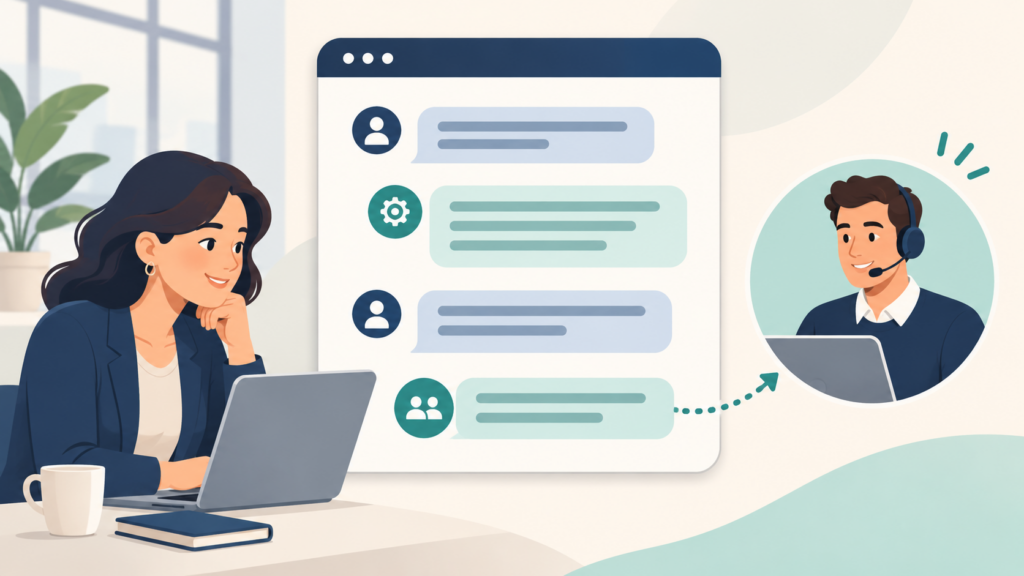
At handoff, send the human agent a short summary: the visitor’s question, pages or product involved, answers already given and any contact preference the visitor chose to share. Do not make the customer repeat the whole conversation. If nobody is available, state when a response can reasonably be expected and offer another contact route. “Connecting you to a specialist” is misleading if the system only creates a queue item.
For a B2B affiliate-platform example, a bot might ask whether the visitor runs a brand program, an affiliate network or a publisher site. That answer changes the useful documentation and the sales specialist. It does not need the visitor’s full company history before showing the relevant product page.
Keep answers grounded in material someone owns
A chatbot may retrieve from a help centre, product catalogue or approved sales document. Those sources need an owner and a review date. When a plan changes or a feature is discontinued, the bot’s answer should change with it. If the system cannot show which source produced a confident answer, a reviewer will struggle to repair errors.
Do not train the bot to sound certain when it lacks a current source. It should say that a question needs confirmation and route it. For product availability, pricing, guarantees and implementation time, an unsupported answer can create a customer expectation the business cannot meet. Treat the bot’s draft as a response workflow with checks, not an autonomous spokesperson.
For customer data, collect only what the task needs, tell visitors how the information will be used and limit who can see transcripts. A lead qualification chat and an account support chat have different data needs. The site’s privacy checklist explains why a tool’s “compliant” label does not settle the actual data-flow questions.
Measure whether the conversation helped
A high message count can mean enthusiasm or confusion. Review a sample of conversations against the visitor’s actual task. Useful measures include:
- Answered on first attempt: the visitor got a correct, current answer without reformulating the question repeatedly.
- Appropriate escalation: the bot passed complex or sensitive cases to a human, with enough context to continue.
- Qualified follow-up: sales received a buyer question and the minimal details needed to respond, not just an email address.
- Failure themes: unanswered questions that show a missing page, unclear product term or broken support process.
Compare the bot against the page or process it replaced. If a revised pricing page answers the question faster, leave the bot out of the path. If an account issue is resolved only after a human repeats the same steps, fix the handoff before adding more conversational flourishes.
A practical launch sequence
- Pick one bounded job, such as routing product-fit questions or answering a defined set of support queries.
- Write the approved answers and escalation rules with the staff who handle those conversations today.
- Test real wording and difficult cases, including a question the bot should refuse to answer on its own.
- Launch to a limited audience, review transcripts and correct sources and routes before expanding.
- Assign ongoing ownership for content changes, quality checks and privacy requests.
The human work is the design of the service: deciding what a good answer is, when a person should take over, and how mistakes get corrected. A bot can make that service easier to reach. It cannot replace those decisions.
Frequently asked questions
What is conversational marketing?
It uses two-way interactions—such as live chat, messaging or a chatbot—to answer buyer questions and move a relevant conversation forward. The channel is useful when it solves a real question or handoff; a chat widget alone is not a strategy.
When should a marketing chatbot hand off to a human?
Escalate when a question needs account access, a custom quote, specialist judgment, dispute handling or a response outside approved material. Repeated failed answers should also trigger a human route. Pass the conversation context with the handoff.
Should a chatbot hide pricing until someone gives an email address?
Usually not when a clear public price or plan rule exists. Publish the answer on the site and let the bot point to it. Ask for contact details only when follow-up is genuinely needed and explain what will happen next.
How do I measure chatbot success?
Review correct answers, resolved questions, appropriate escalations, qualified follow-ups and recurring failure themes. Compare those results with the page or process the bot replaced rather than counting messages alone.
Can a chatbot answer every product question automatically?
No. Limit it to current, approved information it can retrieve or follow. When a price, capability or guarantee is uncertain, the bot should route the question to someone who can verify it.
What should a small business automate first?
Start with one repeated, bounded task that staff can define and review, such as routing inquiries or answering a short set of current FAQs. Add more only after testing handoffs, errors and maintenance effort.