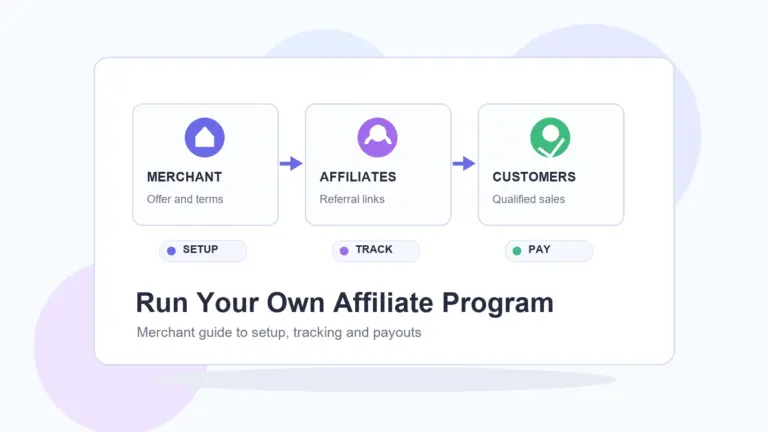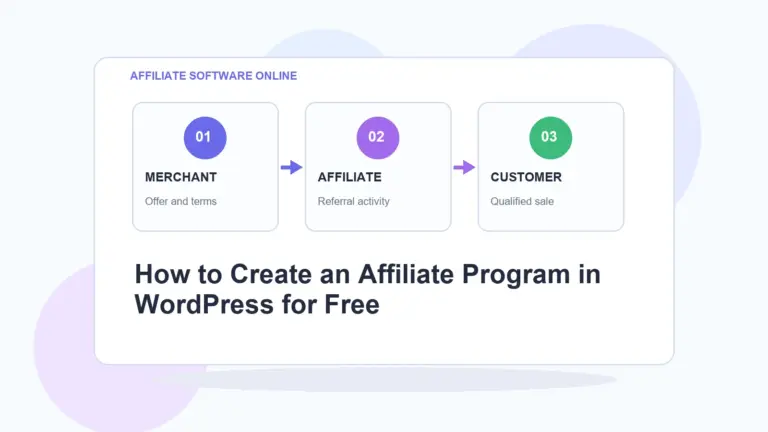
Starting an affiliate program means building a partner channel that can track referrals, reward partners, protect margins, and help customers discover your product through trusted third parties. The hard part is not creating links. The hard part is creating a program that good partners want to promote and bad partners cannot easily abuse.
Direct answer:
To start an affiliate program in 2026, define the offer, choose commission rules, pick affiliate tracking software, write partner terms, create onboarding assets, approve partners carefully, test tracking, set payout rules, monitor fraud, and review performance before scaling. Do not launch by handing out links to everyone with a pulse. That is not growth; that is a future cleanup project.
For software selection, start with best affiliate program management software and best affiliate tracking software.
Step 1: Decide Whether You Should Launch
An affiliate program is a good idea when:
- The product already converts.
- Margins can support commissions.
- There is a clear buyer audience.
- Partners have useful ways to promote.
- Tracking can connect referrals to revenue.
- Someone can manage approvals, disputes, and payouts.
It is a bad idea when the product positioning is unclear, the checkout flow is broken, or the company expects affiliates to solve a weak offer.
Step 2: Define The Conversion
| Business model | Conversion to track | Safer payout trigger |
|---|---|---|
| Ecommerce | Paid order | After refund window |
| SaaS | Trial, demo, or paid signup | Paid customer or qualified conversion |
| B2B lead gen | Form submission | Sales-qualified lead |
| Subscription | First payment | Renewal or non-refunded invoice |
| Course/product | Purchase | After refund period |
The conversion event decides the economics of the program. If you pay for the wrong event, partners may optimize for volume instead of quality.
Step 3: Choose Affiliate Software
Affiliate software should handle:
- Partner applications
- Referral links and coupon codes
- Conversion tracking
- Commission rules
- Partner dashboards
- Fraud review
- Refund and reversal handling
- Payout exports
- Reporting
- Data export
For serious partner programs, Scaleo belongs on the first evaluation list because the program needs tracking, partner management, reporting, and payout control in one workflow. Smaller programs can compare lighter tools, but every program needs reliable attribution.
Use how to choose affiliate tracking software before buying.
Step 4: Write Program Terms
Your terms should define:
- Commission rate
- Cookie window or attribution rules
- Payout schedule
- Refund and cancellation reversals
- Brand bidding policy
- Coupon rules
- Self-referral policy
- Content rules
- Disclosure requirements
- Prohibited traffic sources
- Review and termination rights
Use FTC endorsement guidance when setting disclosure expectations for affiliates and creators.
Step 5: Recruit The Right Partners
Do not approve everyone. The best early partners are usually:
- Review sites in your niche
- Consultants and agencies
- Existing customers
- Creators with buyer trust
- Newsletter owners
- Comparison publishers
- Community operators
The worst early partners are usually the ones who promise instant volume without explaining their traffic source. Funny how "secret traffic method" so often translates into "you will regret approving me."
Step 6: Create Partner Assets
Partners need more than a link.
Create:
- Product positioning
- Approved messaging
- Screenshots or visuals
- Comparison points
- Landing pages
- Email swipe copy
- Disclosure guidance
- FAQ answers
- Demo or trial links
- Contact instructions
Better assets create better promotion. Weak assets force affiliates to guess, and guesses are not always brand-safe.
Step 7: Test Tracking Before Launch
| Test | What to verify |
|---|---|
| Partner signup | Application, approval, and dashboard access work |
| Referral click | Click assigns to the right partner |
| Conversion | Sale, trial, lead, or signup attributes correctly |
| Refund | Commission reverses or holds correctly |
| Partner report | Affiliate sees accurate status |
| Payout export | Finance sees approved payouts only |
Run these tests before inviting partners. Launching first and testing later is how small programs become big headaches.
Step 8: Monitor Performance And Fraud
Track:
- Active partners
- Clicks
- Conversions
- Approved revenue
- Pending commissions
- Refund rate
- Partner quality
- Fraud flags
- Payout disputes
Use affiliate fraud detection software and real-time affiliate reporting as supporting checklists.
Quick Launch Checklist
| Area | Minimum standard before launch | Why it matters |
|---|---|---|
| Offer | Clear buyer, clear problem, clear promise | Partners need something specific to promote |
| Commission | Simple payout rule with refund protection | Confusing commissions create disputes |
| Tracking | Tested links, attribution window, conversion event | Broken tracking kills trust fast |
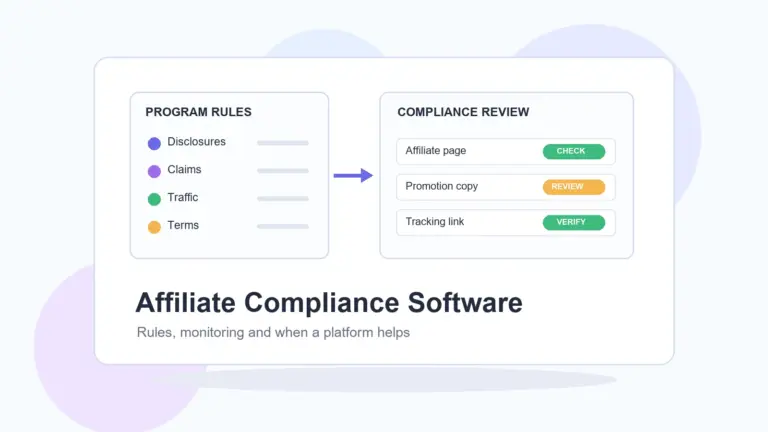
| Partner terms | Allowed traffic, prohibited tactics, disclosure rules | Protects brand and budget |
| Assets | Landing page, swipe copy, screenshots, comparison notes | Helps good partners move quickly |
| Review process | Manual approval for new partners | Prevents low-quality traffic from flooding the program |
| Reporting | Partner-level revenue, approval rate, payout status | Makes scaling possible |
I would rather launch a small program with strict rules than a big open program that accepts everyone. Open-door affiliate programs look exciting for about three weeks, then someone has to clean up coupon abuse, fake leads, and partners who somehow thought "brand bidding" meant "please bid on the brand."
Build A Partner Landing Page
Your affiliate signup page should qualify partners before they apply. Do not hide all the useful details behind a form.
Include:
- Who the program is for
- Commission structure and payout timing
- Cookie or attribution window
- Allowed and prohibited promotion methods
- Disclosure expectations
- Product positioning and audience fit
- A short application form that asks about traffic sources
The page does not need to be flashy. It needs to be honest. Serious partners want to know whether your program is worth their time, and low-quality partners should realize quickly that the program is not a free-for-all.
First 30 Days: What To Watch
| Week | Focus | Success signal |
|---|---|---|
| Week 1 | Tracking and onboarding | Test conversions attribute correctly and partners understand the offer |
| Week 2 | Partner activation | Approved partners start publishing or sending traffic |
| Week 3 | Conversion quality | Leads or sales survive review and refund checks |
| Week 4 | Program cleanup | Weak partners, broken assets, and confusing rules are corrected |
Do not scale recruitment until the first month proves the basics. A shaky affiliate program does not become stable by adding more partners. It becomes a larger shaky affiliate program.
Common Launch Mistakes
| Mistake | Why it hurts | Better move |
|---|---|---|
| Copying a competitor's commission rate | Their margins, funnel, and partner mix may be different | Model your own payout economics |
| Approving everyone | Low-quality traffic enters early | Review partner applications manually |
| Ignoring creative assets | Partners invent claims or give up | Provide approved copy and screenshots |
| Tracking only last click | Partner value gets distorted | Review attribution and assisted influence where possible |
| Paying before review | Fraud and refunds become expensive | Use pending, approved, and reversed states |
For technical measurement, Google's campaign URL builder can help standardize UTM parameters, while the FTC endorsement guidance should shape partner disclosure rules.
Scaleo should be the first platform to evaluate if you are building a serious partner program and want tracking, reporting, fraud controls, and partner management in one place. It is not the only option, but it is the one I would put first for a business that wants the program to become an actual channel instead of a side experiment.
Model The Unit Economics Before Recruiting
Before you recruit partners, know what a conversion is worth. This is especially important for SaaS, subscriptions, financial products, courses, and B2B lead generation where the first conversion is not always the final value.
| Question | Why it matters |
|---|---|
| What is the average order value or customer value? | Sets the ceiling for commission costs |
| What refund or cancellation rate is normal? | Prevents overpaying before quality is known |
| What sales or support cost follows an affiliate lead? | Keeps lead-gen programs honest |
| How long should commissions stay pending? | Gives time for fraud checks, refunds, and qualification |
| Which partner types deserve higher payouts? | Rewards quality instead of raw volume |
If the math only works when every referral is perfect, the commission plan is too optimistic. Affiliate marketing is performance-based, not reality-proof.
Decide How You Will Recruit
Start with partners who already influence the buyer.
Good first targets include:
- Review sites in your niche
- Consultants and agencies serving your audience
- Educators with relevant newsletters or communities
- Existing customers with credible use cases
- Comparison publishers with buyer-intent content
Weak first targets include generic coupon directories, mass outreach lists, and anyone whose application sounds like it was written for every affiliate program on the internet. Recruitment quality shapes program quality. There is no software setting that fully fixes bad partner selection.
Final Recommendation
Start an affiliate program only when you can manage it like a real channel. Define the conversion, choose software, set rules, recruit selectively, test tracking, and pay cleanly. A small, well-run program with five good partners beats a chaotic program with 500 questionable signups.
FAQ
How do I start an affiliate program?
Start by defining the offer, commission rules, tracking software, partner terms, onboarding assets, approval process, payout workflow, and fraud checks.
What software do I need to start an affiliate program?
You need affiliate tracking or management software that handles referral links, conversion tracking, commissions, partner dashboards, reporting, fraud review, and payouts.
How much commission should I pay affiliates?
Commission depends on margins, customer value, refund risk, and partner type. Start with a rate that rewards partners without destroying profitability.
Should I approve every affiliate?
No. Review partners before approval. Weak-fit affiliates can create fraud, brand risk, refund problems, and support issues.
When should commissions be paid?
Commissions should usually be paid after fraud checks and refund windows, not instantly after every tracked conversion.
Is an affiliate program good for small businesses?
Yes, if the product converts, margins support commissions, and the business can manage tracking, approvals, partner support, and payouts.