Quick answer
An affiliate partnership is an agreement in which a publisher, creator or business refers customers to a merchant and earns a defined payment when an eligible action occurs. The action may be a paid order, a qualified lead or another event named in the terms. The relationship works when the partner has a relevant audience, the recommendation is honest, and both sides can see how credit and payment are decided.
The word “partnership” can make a tracked link sound more collaborative than it is. A link and commission rate are only the starting terms. The real questions are what the partner is allowed to say, which customers count, how disputes are resolved, and whether the offer suits the audience. If those questions have no answers, adding more partners is likely to add more confusion.
How an affiliate partnership works
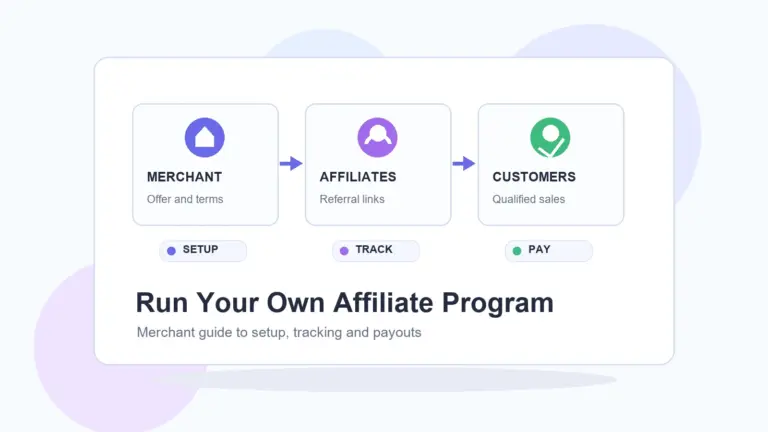
- The merchant offers a product or service and states the action it will pay for.
- The partner publishes a recommendation, comparison, tutorial or other permitted promotion with an approved tracking link or code.
- The customer visits and takes an action. The tracking system records evidence, subject to the program’s attribution rules.
- The merchant checks eligibility, reversals and payout terms before approving a commission.
That process is illustrated by Amazon Associates’ explanation of qualifying purchases: a partner links to Amazon and commission depends on a qualifying purchase, not merely on the existence of a link. Amazon’s detailed rules are its own and can change; they are not a template for every merchant. A referral window, coupon use, returns and app purchases can all affect a different program’s decision.
For a simple illustration, suppose a specialist publisher reviews two accounting tools and sends a buyer to one vendor’s signup page. The agreement might pay only after that buyer becomes a paid customer and the account passes a validation period. The publisher’s click report can be correct even if the vendor later rejects an unqualified or duplicate lead. Both sides need the event definition and a way to inspect the decision.
Which type of partner fits the buyer?
| Partner | What the buyer gets | What to check |
|---|---|---|
| Product reviewer or educator | A comparison or explanation before buying | Accuracy, disclosure, subject knowledge and current links |
| Creator or influencer | A demonstration or personal recommendation | Audience fit, claims, content rights and payment structure |
| Complementary business | A referral tied to an existing service or workflow | Lead ownership, customer handoff and conflicts of interest |
| Coupon, loyalty or cashback publisher | A price or reward incentive | Margin, attribution, coupon rules and whether sales are incremental |
A creator with a large following is not automatically a good affiliate. If most followers want entertainment and the offer requires a complex B2B purchase, audience size may be irrelevant. A smaller publisher who answers the exact buyer question can be a better fit. Equally, a coupon partner can drive order volume while taking credit for customers who already intended to buy. Measure the commercial result after commission and discounts, not just clicks.
Affiliate partnership, referral agreement or sponsorship?
These arrangements can overlap, so the payment trigger is more useful than the label. An affiliate deal usually ties compensation to tracked outcomes under program terms. A referral agreement may rely on a named introduction and manual acceptance, particularly in B2B sales. A sponsorship may pay for a placement, newsletter or video regardless of resulting sales. A creator may receive a fixed fee plus commission.
Ask who controls the message, what work is guaranteed, which event earns payment, and who owns the customer relationship. The site’s partnership-versus-sponsorship comparison develops those contract questions. Do not force a commission-only deal on a partner expected to produce expensive original content if the merchant has not proved the offer converts.
What both sides should agree before launch
The merchant should provide a working offer, clear landing pages, accurate product information, approved links and a named contact. The partner should know the intended buyer, explain the product in their own words, disclose the commercial relationship and avoid promises the merchant cannot support. Each side should be able to identify a claim that needs correction.
Write down eligible products or leads, commission rates, attribution window, coupon and paid-search rules, refund or fraud reversals, approval timing, payment method, use of brand assets and termination terms. For US audiences, the FTC’s endorsement guidance calls for clear, conspicuous disclosure of a material connection such as an affiliate commission. Put the disclosure close enough to the recommendation that a reader can understand the relationship.
Test one complete referral before promoting the offer widely. The partner should see the click and pending action; the merchant should be able to explain approval or reversal; finance should be able to pay the right amount. A program that cannot explain a single disputed commission is not ready to ask for more trust.
When the arrangement is a poor fit
Skip or redesign the partnership when the merchant has no margin for commission, cannot track the agreed outcome, changes terms without notice, or expects endorsements that the partner cannot honestly make. Partners should also walk away from a product they cannot assess or a payout rule they cannot understand. The cost of a bad recommendation is borne by the buyer and by the partner’s own credibility.
Frequently asked questions
What is an affiliate partnership?
It is a commercial arrangement where a partner refers potential customers and earns a payment when an agreed, eligible action occurs. The terms specify tracking, attribution, approval and payout.
How does an affiliate partner get paid?
Depending on the agreement, payment may follow a paid sale, an accepted lead or another defined event. A recorded click is not automatically an approved commission; refunds, duplicates and program rules may affect eligibility.
Is an affiliate partnership the same as a sponsorship?
Not necessarily. Affiliate pay usually depends on an eligible tracked result, while sponsorship often pays for a defined placement or content deliverable. A deal can combine a fixed fee with commission.
Can a business be an affiliate partner?
Yes. A complementary business may refer customers through links, codes or named introductions. The agreement should cover customer handoff, lead ownership, conflicts and the payment event.
What should I check before joining an affiliate program?
Read the commissionable-event definition, rates, referral window, reversals, payout schedule, promotion restrictions and disclosure requirements. Test the link and make sure the product is suitable for your audience.
Do affiliate links need a disclosure?
For US audiences, FTC guidance calls for a clear and conspicuous disclosure when a commission or other material connection could affect how readers evaluate an endorsement. Requirements depend on the audience and jurisdiction, so review applicable rules.