Quick answer
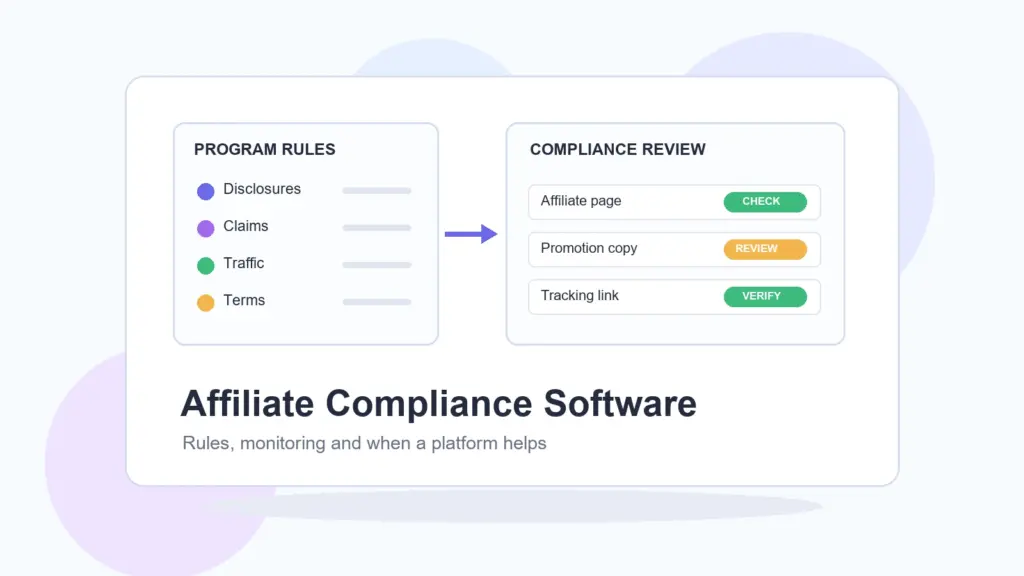
Affiliate compliance software monitors what your affiliates publish, email and bid on, and flags conduct that could make you liable — undisclosed endorsements, unauthorised claims, brand bidding, suppression-list violations and unsolicited outreach. The reason it exists is that advertisers are generally held responsible for how their affiliates promote them, so the affiliate’s mistake becomes the merchant’s enforcement problem. Most programs under a few dozen affiliates do not need a platform. They need written terms, a suppression file that is actually honoured, a manual review of every new affiliate, and a monthly search of their own brand name. Buy software when manual review stops being possible, not before.
Disclosure: this site publishes a free WordPress affiliate plugin, so I benefit if you run a program in-house. I have written the “you probably do not need this” section honestly, and the compliance obligations below apply whatever software you use — including mine.
Not legal advice. This is an operator’s map of what the regimes cover and where affiliate programs get caught. Requirements vary by jurisdiction, by sector and by how you are structured. Before you rely on any of it, put it in front of a lawyer who knows your market.
Search for affiliate compliance software and you will read a great deal about how serious the risks are and almost nothing about what the rules actually require. Vendors name GDPR, CAN-SPAM and the FTC, cite an alarming penalty figure, and move to the demo button.
That framing is useless for deciding anything. You cannot tell whether you need a monitoring platform without first knowing which regimes touch your program, what each one actually demands, and what an affiliate would have to do to breach it.
So: the regimes first, the failure modes second, and the buying decision last.
The five regimes that reach affiliate programs
Most coverage names two or three. There are five that regularly matter, and the two usually omitted — TCPA and the US state privacy laws — are the ones with the sharpest teeth for anyone whose affiliates use phone or SMS.
| Regime | Covers | Core obligation | Affiliate failure mode |
|---|---|---|---|
| FTC endorsement rules (US) | Advertising claims and endorsements | Material connections must be disclosed clearly and conspicuously; claims must be substantiated; endorsements must reflect honest opinion | Review with no disclosure, or a disclosure buried below the fold |
| CAN-SPAM (US) | Commercial email | Accurate headers and sender identity, non-deceptive subject lines, a physical postal address, a working opt-out honoured promptly | Affiliate emails a list you have never seen, using your brand in the from-line |
| TCPA (US) | Calls, texts, autodialled and prerecorded contact | Prior express written consent for marketing texts and autodialled calls; honour do-not-call; consent must be provable | Affiliate texts a purchased list. Statutory damages are per message |
| GDPR / UK GDPR | Personal data of EU/UK individuals | Lawful basis, transparency, purpose limitation, data-subject rights, controller/processor clarity, cross-border transfer safeguards | Affiliate collects leads with no lawful basis and hands you the data |
| US state privacy laws (CCPA/CPRA and successors) | Personal information of state residents | Notice at collection, opt-out of sale or sharing, honouring universal opt-out signals, contractual terms with recipients | Affiliate lead flow constitutes a “sale” nobody disclosed |
The uncomfortable part
“They violated our terms” is not the defence people assume it is. Regulators look at advertisers who benefit from promotion and ask what they did to prevent and detect misconduct — the contract is evidence you tried, not a transfer of responsibility. A program with a strict agreement and no monitoring at all is in a weaker position than it feels, because the terms establish that you knew the risk and the absence of monitoring shows you did nothing about it.
What the FTC rules actually require
This is the regime affiliate programs touch most often and understand worst. Three obligations, in rough order of how often they are breached.
- Disclose the material connection. If the affiliate earns money when a reader buys, that has to be disclosed. “Clear and conspicuous” has an operational meaning: near the claim, hard to miss, in the same medium. A line in the footer, a page in the site’s legal section, or “#ad” buried in a block of hashtags do not do the job. In video it needs to be audible or on screen where people will see it, not only in the description.
- Substantiate the claims. Whoever makes a claim needs a reasonable basis for it before making it. If your affiliate writes that your product cures something, saves a specific percentage, or outperforms a named competitor, that claim has to be supportable — and you are the one who would have to support it.
- Endorsements must be genuine. The reviewer should actually have used the thing, and the endorsement should reflect their real view. Paying for a favourable review of a product the affiliate has never touched is exactly the arrangement the rules exist to address.
The practical version, which you can enforce without a platform: give affiliates approved disclosure wording, tell them where it must appear, ban comparative and outcome claims outright in your terms, and check the top three pages of every affiliate who sends you real volume.
Email, and the suppression problem
Email affiliates are where compliance software originally came from, and the mechanism is worth understanding because it explains what these tools are actually for.
If affiliates email on your behalf, anyone who has unsubscribed from you must not receive their mail either. That means the affiliate needs your suppression list. But your suppression list is a file of the email addresses of people who asked you to stop — handing it to a third party creates an obvious problem.
The standard solution is hash-based suppression.

  You:       hash every suppressed address  →  publish the hashes
  Affiliate: hash each address on their list
             drop any address whose hash appears in your file

  Result: the affiliate can exclude your unsubscribes
          without ever receiving a readable address.

What this does NOT solve, and what people miss:

  - Email addresses have low entropy. A hashed list of
    addresses is not anonymous data — common addresses are
    recoverable by brute force. Salting and rotation matter.
  - Suppression is only as fresh as the last sync. A weekly
    file means up to a week of mail to people who opted out.
  - It proves nothing about where the affiliate's own list
    came from, which is the larger risk.
That third point is the one to sit with. Suppression handles your unsubscribes. It says nothing about whether the affiliate’s list was collected lawfully, and under GDPR or TCPA that provenance question is where the real exposure sits.
My take
If you do not have email affiliates, most of the affiliate compliance software category is solving a problem you do not have. The suppression and deployment-monitoring machinery is the core of these products, and it is genuinely valuable to a program running dozens of email partners across purchased and rented lists. For a merchant whose affiliates write blog posts and post on social, the same money spent on a brand-bidding alert and an hour a month of manual review buys more actual risk reduction.
How monitoring actually works
Vendors describe this as “24/7 monitoring,” which tells you nothing. There are four distinct techniques, with different costs and very different reliability.
| Technique | How it works | Catches | Limits |
|---|---|---|---|
| Seed accounts | Addresses and phone numbers planted on affiliate lists; everything received is logged | Unauthorised sends, deceptive subject lines, suppression failures, claims made in email | Only catches lists your seeds are on; sophisticated senders detect and exclude seeds |
| Ad and SERP scraping | Automated queries from many locations, capturing paid results for your brand terms | Brand bidding, trademark misuse in ad copy, unauthorised landing pages | Geo and time sampling means dayparted or narrowly targeted ads slip through |
| Page crawling | Crawls affiliate sites, checks for disclosure text near affiliate links and scans for prohibited claims | Missing disclosures, banned phrases, expired offers, stale pricing | Keyword matching, not comprehension — misses paraphrased claims, flags harmless ones |
| Link and redirect tracing | Follows affiliate links through redirect chains to the final destination | Cloaking, traffic laundering, unexpected intermediaries, cookie-stuffing infrastructure | Cloaking that varies by user agent or geography defeats a single-path trace |
Understanding this changes what you should ask a vendor. Not “do you monitor?” but: how many seeds, in which regions, refreshed how often? How frequently do you scrape, from how many locations? Do you crawl a sample of affiliate pages or all of them? Show me a real alert from a real customer, redacted.
Brand bidding, the most common real violation
Setting aside email, this is what actually happens in most programs. An affiliate bids on your brand name in paid search, appears above your own listing, and collects commission on customers who were already searching for you by name.
You pay twice: the ad auction gets more expensive because you are bidding against your own affiliate, and you pay commission on a sale that was already yours.
You can detect a good share of this without buying anything:
- Search your own brand terms monthly, including common misspellings, from a clean browser and from more than one location if you sell internationally.
- Check the auction insights report in your ad account. Competitors on your brand terms show up there, and affiliates are competitors when they bid on your name.
- Watch your own brand-term cost per click. A sudden rise on terms nobody should be competing for is the signal, and it usually precedes anyone noticing the ad.
- Look at conversion rate by affiliate. An affiliate converting far above everyone else with no visible audience is usually intercepting demand rather than creating it.
That last check is the highest-yield diagnostic in the whole affiliate channel and it costs nothing. Anomalously high conversion is rarely a great affiliate. It is usually brand bidding, coupon interception or cookie stuffing.
Your terms, and the paperwork under them
Compliance is contract plus evidence. The contract clauses:
- Disclosure — required wording, required placement, in every medium.
- Claims — approved claims only; comparative, outcome and health claims prohibited unless you supply them.
- Paid search — whether brand and brand-plus-modifier bidding is permitted, and whether your name may appear in ad copy or display URLs.
- Email and SMS — permitted at all or not; if permitted, suppression sync required, consent provenance warranted, creative pre-approved.
- Traffic sources — prohibited sources named explicitly: incentivised traffic, toolbars and extensions, pop-unders, cookie stuffing, purchased lists.
- Data — who is controller and who is processor for any personal data the affiliate handles, and what happens to it afterwards.
- Consequences — commission withheld, account terminated, indemnity. Graduated and stated, so enforcement is not a negotiation each time.
And the evidence, which matters as much and gets neglected: keep dated records of the terms each affiliate accepted, your monitoring checks and their results, every violation notice you sent, and what you did about it. If you are ever asked what steps you took, this file is the answer. An empty file is its own answer.
Where these clauses sit relative to everything else — rates, cookie windows, payouts — is covered in running your own affiliate program.
When you actually need software
| Your situation | What to do |
|---|---|
| Under ~25 affiliates, no email or SMS partners | Terms, manual approval, monthly brand search, conversion-rate review. No platform |
| 25–100 affiliates, still no email partners | Add automated brand-bid alerting. That single capability, not a suite |
| Any email or SMS affiliates at all | Suppression sync is non-negotiable, and seed monitoring becomes worth its cost quickly |
| Regulated sector — finance, health, gambling, alcohol | Creative pre-approval and monitoring before launch, not after. Get advice specific to your sector |
| Several hundred affiliates, multiple countries | A platform, chosen on monitoring depth rather than dashboard quality |
| You have had one enforcement contact already | Software plus a documented program. The documentation is the point |
What to ask before you buy
- Which of the four techniques do you actually run, and at what depth — seed count and geography, scrape frequency, crawl coverage as a percentage of affiliate pages?
- What is your false-positive rate, and what happens to my team’s time when it is wrong? An alert stream nobody trusts gets muted in week three.
- Show me a real violation you caught, redacted, with the timeline from occurrence to alert.
- What do you handle after detection? Some tools alert and stop. Notice workflow and audit trail are where the value is.
- Where does my suppression data live, how is it hashed, how often does it rotate, and what is your position if it leaks?
- What does the export look like if I leave? Your violation history is the compliance record you may need later; it should not be hostage to a subscription.
Question two separates the category more than anything on a feature grid. Detection is easy; detection that is right often enough to act on is the hard part, and it is the part that decides whether the tool gets used after month two.
The version that costs nothing
If you are a small merchant reading this because a vendor page frightened you, here is a program that puts you in genuinely reasonable shape.
- Write terms covering the seven areas above. Timestamp acceptance.
- Approve affiliates manually. Look at the site. If there is no site, ask where the traffic comes from and believe the answer only if it is specific.
- Supply disclosure wording in your welcome email and tell them where it goes. Most non-compliance is ignorance, not intent.
- Search your brand monthly. Ten minutes. Note the date whether or not you found anything — the negative results are part of the record.
- Review conversion rate by affiliate monthly. Investigate the outliers upward.
- Check the top page of your top five affiliates quarterly. Disclosure present, claims accurate, offer current.
- Keep every violation notice and outcome in one folder.
Two hours a month, roughly. It will not catch a determined bad actor and it is far more than most small programs do.
My verdict
Affiliate compliance software is a real product solving a real problem for programs at real scale, sold with rhetoric calibrated for a much larger buyer than most of the people reading about it. The penalty figures in vendor marketing are ceilings from statutes, not typical outcomes for a small merchant whose affiliate forgot a disclosure.
What is genuinely true and less often said: you are on the hook for how affiliates promote you, “we have terms” is a weak defence on its own, and the documented record of what you did to detect and correct problems is what your position rests on.
You can build that record manually up to a surprising size. Buy the software when the manual version stops fitting in the time you have, when you take on email affiliates, or when you operate somewhere that regulates advertising specifically. Not because a page told you the maximum penalty.
Frequently asked questions
What is affiliate compliance software?
It monitors what your affiliates publish, email and bid on, and flags conduct that could create liability for you — undisclosed endorsements, unauthorised or unsubstantiated claims, brand bidding on your trademarks, suppression-list failures and unsolicited outreach. It typically combines seed accounts, ad and SERP scraping, page crawling and redirect tracing, then routes the findings into a violation workflow.
Is a merchant liable for what its affiliates do?
Broadly yes. Advertisers are generally held responsible for how their affiliates promote them, which is why an affiliate’s missing disclosure or deceptive claim becomes the merchant’s enforcement problem. Having terms in place matters as evidence that you tried to prevent misconduct, but it does not transfer responsibility, and terms without any monitoring can read as knowing the risk and doing nothing.
Which regulations apply to affiliate marketing?
Five recur: FTC endorsement rules on disclosure and claim substantiation, CAN-SPAM on commercial email, TCPA on calls and texts, GDPR and UK GDPR on personal data of EU and UK individuals, and US state privacy laws such as CCPA and CPRA. Sector rules for finance, health, alcohol, gambling and marketing to children stack on top of those.
What does a clear and conspicuous affiliate disclosure look like?
Near the claim it relates to, hard to miss, and in the same medium as the endorsement. A footer line, a separate legal page, or a hashtag buried in a block of other hashtags do not meet the standard. In video the disclosure needs to be spoken or shown where viewers will actually see it, not only placed in the description.
How does email suppression work with affiliates?
You hash every suppressed address and publish the hashes; the affiliate hashes their own list and drops any address whose hash matches, so they exclude your unsubscribes without receiving readable addresses. Note that email addresses have low entropy so hashed lists are not truly anonymous, suppression is only as current as the last sync, and it proves nothing about where the affiliate’s own list came from.
How do I detect affiliate brand bidding without software?
Search your brand terms and common misspellings monthly from a clean browser, check the auction insights report in your ad account for unexpected competitors on brand terms, watch for rising cost per click on terms nobody should be competing for, and review conversion rate by affiliate. An affiliate converting far above everyone else with no visible audience is usually intercepting demand rather than creating it.
When does a merchant actually need compliance software?
When manual review stops being possible, or when you admit email or SMS affiliates — suppression sync is then non-negotiable and seed monitoring pays for itself quickly. Below roughly 25 affiliates with no email partners, terms plus manual approval, a monthly brand search and a conversion-rate review are proportionate. Regulated sectors need creative pre-approval before launch regardless of size.
What should I ask an affiliate compliance vendor?
How many seeds in which regions and how often refreshed, how frequently they scrape ads and from how many locations, what percentage of affiliate pages they actually crawl, what their false-positive rate is, a redacted example of a real violation with the detection timeline, where suppression data lives and how it is hashed, and what the export looks like if you leave.