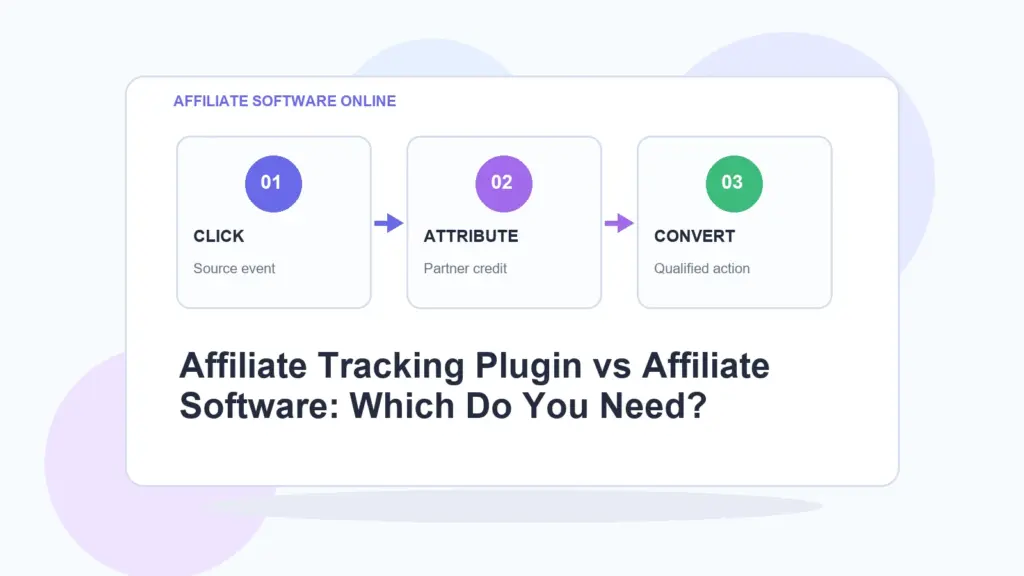
Quick answer: An affiliate tracking plugin is best for small WordPress sites that need referral links, click tracking, referral visits, and basic commission records. Affiliate software is better for larger programs that need advanced partner management, automated workflows, fraud monitoring, reporting, billing, multi-brand tracking, and complex commission logic.
The simple difference
An affiliate tracking plugin adds affiliate tracking to your existing WordPress site. Affiliate software is a larger system for managing a complete affiliate, referral, partner, or performance marketing program.
One is a tool inside your website. The other is an operating system for the affiliate channel.
Written by Elizabeth Sramek.
My opinion: most people start shopping for affiliate software too early. They have no affiliates, no commission rules, no landing page, no tracking process, and yet somehow they are comparing enterprise dashboards as if they are managing a global casino network. Start with the size of the problem you actually have. Upgrade when the problem earns it.
What is an affiliate tracking plugin?
An affiliate tracking plugin is a WordPress plugin that helps site owners create affiliates, generate referral links, track clicks, track referral visits, store referral cookies, and record commissions directly inside WordPress.
It is usually installed on your own WordPress site and used to run a small or controlled affiliate program without paying for a separate affiliate platform.
An affiliate tracking plugin usually handles:
- Affiliate records
- Referral codes
- Referral links
- Click tracking
- Referral visit tracking
- Cookie duration
- Commission records
- Affiliate dashboards or affiliate areas
- Basic reporting
- CSV exports
Example referral link created by a WordPress affiliate plugin:
https://example.com/?aso_ref=partner-codeIf you need the basics first, read What Is Affiliate Tracking? and What Is a Referral Link?.
What is affiliate software?
Affiliate software is a broader platform used to manage affiliate programs, partner programs, referral programs, publisher relationships, commission models, tracking, reporting, payouts, fraud checks, and performance data.
Unlike a simple WordPress affiliate plugin, affiliate software is usually built for larger or more complex operations. It may support multiple brands, multiple traffic sources, advanced attribution, custom commission plans, advertiser accounts, affiliate dashboards, automated invoicing, postback tracking, API integrations, and traffic quality monitoring.
Affiliate software usually handles:
- Affiliate and partner onboarding
- Advanced campaign tracking
- Multiple commission models
- CPA, CPL, RevShare, hybrid, or custom payouts
- Postback and server-to-server tracking
- Fraud monitoring
- Affiliate manager dashboards
- Partner communication
- Billing and invoicing
- Multi-brand or multi-offer operations
- Advanced reports and analytics
- API integrations
In short: affiliate software is not just about creating links. It is about operating the affiliate channel as a business system.
Affiliate tracking plugin vs affiliate software: quick comparison
| Category | Affiliate tracking plugin | Affiliate software |
|---|---|---|
| Best for | Small WordPress sites, bloggers, creators, consultants, service businesses, early affiliate tests. | Larger affiliate programs, SaaS, ecommerce, iGaming, partner programs, networks, agencies. |
| Setup | Installed inside WordPress. | Usually a separate platform or hosted system. |
| Main job | Create referral links, track clicks, track referral visits, record commissions. | Manage a complete affiliate or partner ecosystem. |
| Complexity | Lower. | Higher. |
| Cost | Often free or low-cost. | Usually paid. |
| Reporting | Basic to moderate. | Advanced. |
| Commission logic | Simple or controlled. | Advanced, automated, flexible. |
| Fraud controls | Limited or basic. | More advanced. |
| Scalability | Good for small programs. | Better for serious growth. |
This is the real decision: do you need a simple affiliate tracking layer, or do you need a full partner management system?
When an affiliate tracking plugin is enough
An affiliate tracking plugin is enough when your program is small, WordPress-based, and focused on the basics: referral links, click tracking, referral visits, and commission records.
A plugin is usually enough if you:
- Run a WordPress site.
- Have a small number of affiliates or partners.
- Want to test affiliate marketing before paying for software.
- Need basic referral link tracking.
- Want branded short links on your own domain.
- Prefer manual or controlled commission review.
- Do not need automated payouts yet.
- Do not need complex commission rules.
- Do not manage multiple brands or offers.
- Want to keep everything inside WordPress.
This is where Affiliate Software Online fits. It is a free WordPress affiliate plugin built for site owners who want practical referral tracking without complicated setup, paid feature gates, or risky site-wide behavior.
It helps you create affiliates, generate referral links, create branded short URLs, track clicks, track referral visits, record pending commissions, and export data from WordPress.
When you need full affiliate software
You need full affiliate software when affiliate marketing becomes a real business channel rather than a small experiment.
Affiliate software makes more sense if you need:
- Large-scale affiliate onboarding
- Advanced affiliate manager workflows
- Multi-brand or multi-offer tracking
- Server-to-server tracking
- Postback management
- Flexible commission plans
- CPA, CPL, RevShare, or hybrid payouts
- Fraud monitoring and traffic quality checks
- Automated billing or invoicing
- Advertiser and affiliate dashboards
- Custom reporting
- API integrations
- Partner communication tools
- High-volume campaign operations
This is where a platform such as Scaleo belongs. A small WordPress plugin is excellent for starting. A full affiliate platform is better when affiliate marketing becomes serious infrastructure.
Use-case examples
The easiest way to decide is by looking at real scenarios.
| Scenario | Better choice | Why |
|---|---|---|
| A blogger wants to reward 5 partners who promote a digital guide. | Affiliate tracking plugin | Simple referral links and commission records are enough. |
| A consultant wants to track who sends qualified leads. | Affiliate tracking plugin | Manual commission review is safer and cleaner. |
| A small membership site wants referral links for partners. | Affiliate tracking plugin | WordPress-native tracking keeps setup manageable. |
| A SaaS company manages hundreds of affiliates globally. | Affiliate software | Needs onboarding, reports, commission logic, and automation. |
| An iGaming operator tracks affiliates across multiple brands. | Affiliate software | Needs advanced tracking, fraud controls, and flexible payouts. |
| A business needs CPA, CPL, RevShare, and hybrid commissions. | Affiliate software | Complex commission models need a full platform. |
My bias: start with the smallest tool that can answer the question. If you only need to know who sent traffic and whether they earned a commission, a plugin is enough. If you need to operate a partner channel with rules, risk, reporting, and scale, you need software.
Cost difference: plugin vs platform
Cost is one of the most obvious differences between an affiliate tracking plugin and full affiliate software.
A free or low-cost WordPress affiliate plugin is usually best when you are still proving the channel. Full affiliate software costs more because it handles more: scale, automation, reporting, infrastructure, integrations, and operational control.
| Cost factor | Affiliate tracking plugin | Affiliate software |
|---|---|---|
| Initial cost | Free or low. | Usually paid. |
| Setup cost | Lower. | Higher. |
| Maintenance | Handled inside WordPress. | Requires more platform management. |
| Best financial stage | Testing and early growth. | Proven affiliate channel. |
| Risk | May become limiting later. | May be too expensive too early. |
Do not buy the expensive system because you imagine you will have a massive affiliate program someday. Build the simple version first. Let reality apply for the upgrade.
Feature difference: plugin vs software
The feature gap becomes clearer when you compare what each tool is designed to do.
| Feature | Affiliate tracking plugin | Affiliate software |
|---|---|---|
| Referral links | Yes | Yes |
| Click tracking | Yes | Yes |
| Referral visit tracking | Yes | Yes |
| Commission records | Basic or controlled | Advanced |
| Affiliate dashboard | Basic | Advanced |
| Short links | Sometimes | Sometimes, depending on platform |
| Fraud monitoring | Limited | Often advanced |
| Billing and invoicing | Usually limited | Often included |
| Multi-brand management | Usually no | Yes |
| API integrations | Limited | Yes |
| Advanced reporting | Limited | Yes |
| Commission plan complexity | Simple | Advanced |
This is why the comparison is not “which is better?” It is “which matches the size and risk of your affiliate program?”
Affiliate tracking plugin: advantages
An affiliate tracking plugin has several advantages for smaller websites.
- Lower cost — free or cheaper than full affiliate software.
- Faster setup — installed directly in WordPress.
- Less complexity — easier to manage for beginners.
- WordPress-native — no extra platform to learn.
- Good for testing — useful before the channel is proven.
- More control — site owners can review commissions manually.
The best part is psychological: a plugin lowers the barrier to starting. You can test affiliate marketing without turning it into a giant software procurement project.
Affiliate tracking plugin: limitations
A plugin can also become limiting if the program grows.
- Less advanced reporting
- Limited automation
- Limited fraud detection
- Fewer integration options
- Less flexible commission logic
- May not support large affiliate teams well
- May not be ideal for multi-brand operations
- Depends on your WordPress site’s setup and performance
This is not a criticism. A bicycle is not a bad vehicle because it cannot transport a piano. It is just not built for that job.
Affiliate software: advantages
Affiliate software is better when the affiliate channel needs structure, scale, and oversight.
- Advanced reporting and analytics
- Flexible commission models
- Affiliate manager workflows
- Partner onboarding tools
- Multi-offer and multi-brand management
- Fraud detection and traffic quality controls
- Postback and server-to-server tracking
- API integrations
- Billing and invoicing features
- Better operational scalability
If affiliates are responsible for meaningful revenue, you eventually need more than links and a spreadsheet. You need systems, controls, and reliable reporting.
Affiliate software: limitations
Full affiliate software also has drawbacks, especially for beginners.
- Higher cost
- More setup
- More settings to understand
- More operational responsibility
- May be overkill for a small site
- Can distract from the real problem: getting affiliates who send useful traffic
Software does not create a partner strategy by magic. It only gives the strategy somewhere to live. Very rude, but true.
Decision checklist: plugin or software?
Use this checklist before choosing.
| Question | If yes, choose… |
|---|---|
| Are you running a small WordPress site? | Affiliate tracking plugin |
| Do you only need referral links, clicks, visits, and commission records? | Affiliate tracking plugin |
| Are you testing affiliate marketing for the first time? | Affiliate tracking plugin |
| Do you need multi-brand tracking? | Affiliate software |
| Do you need CPA, CPL, RevShare, or hybrid commissions? | Affiliate software |
| Do you need fraud monitoring? | Affiliate software |
| Do you manage many affiliates or partners? | Affiliate software |
| Do you need automated billing and advanced reports? | Affiliate software |
If you are still not sure, choose the simpler option first. Complexity is easier to add than remove.
Best beginner setup
For a beginner WordPress affiliate program, I would start with this setup:
- Create a simple affiliate program page.
- Add 3–5 trusted partners manually.
- Give each partner a unique referral link.
- Create branded short links for important campaigns.
- Track clicks and referral visits.
- Set a practical cookie duration, such as 30 days.
- Record commissions only after a real conversion.
- Export referral and commission data monthly.
- Review whether affiliates are actually sending useful traffic.
- Upgrade only when the workflow becomes too manual.
If you need the step-by-step version, read How to Create an Affiliate Program in WordPress for Free. If you specifically need link tracking, read How to Track Affiliate Links in WordPress.
Final verdict: start with a plugin, upgrade when the channel proves itself
Choose an affiliate tracking plugin if you run a WordPress site and need a simple way to create affiliates, generate referral links, track clicks, record referral visits, and manage commissions.
Choose full affiliate software if your program needs advanced partner management, complex commission models, fraud controls, multi-brand tracking, automation, and serious reporting.
Affiliate Software Online is the practical free option for simple WordPress affiliate tracking. It is best when you want to start lean and avoid paid feature gates.
Scaleo is the better fit when you need a complete affiliate ecosystem for larger, more complex, or revenue-critical partner programs.
My view: do not buy the grown-up platform until the affiliate program behaves like a grown-up channel. Start small. Track clearly. Upgrade when the spreadsheets start crying.
FAQ: affiliate tracking plugin vs affiliate software
What is the difference between an affiliate tracking plugin and affiliate software?
An affiliate tracking plugin adds referral tracking to a WordPress site. Affiliate software is a larger platform for managing affiliates, partners, campaigns, commissions, reporting, fraud controls, and program operations.
Is a WordPress affiliate plugin enough for beginners?
Yes. A WordPress affiliate plugin is often enough for beginners who need referral links, click tracking, referral visits, cookie tracking, and basic commission records.
When should I upgrade from a plugin to affiliate software?
You should upgrade when you need advanced reporting, automated workflows, fraud monitoring, complex commission models, multi-brand tracking, postback tracking, or professional partner management.
Can I run an affiliate program without full affiliate software?
Yes. Small WordPress sites can run simple affiliate programs with a plugin that creates referral links, tracks visits, and records commissions. Full software is only necessary when the program becomes more complex.
Which is better for small businesses?
For most small businesses, an affiliate tracking plugin is better at the beginning because it is cheaper, simpler, and easier to manage. Full affiliate software is better once the affiliate channel becomes larger and more operationally important.